
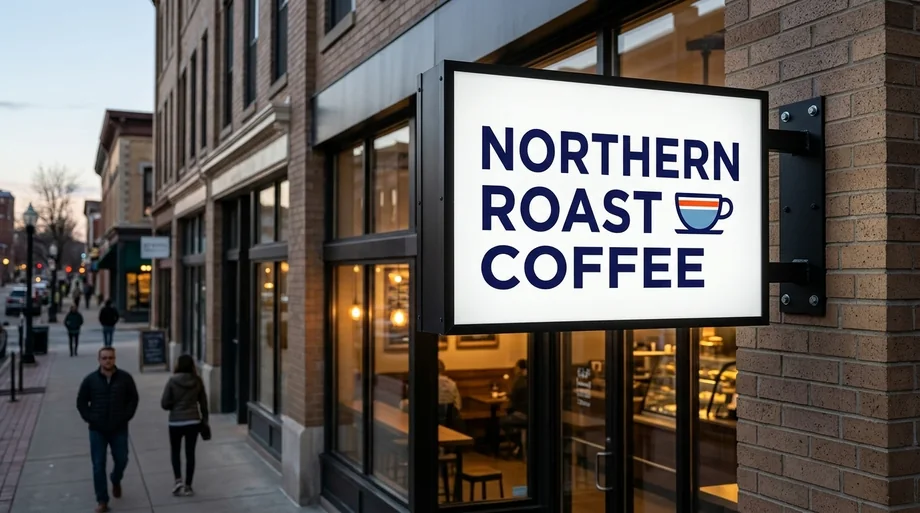
A pedestrian walking down a busy retail corridor rarely looks directly across the street to read flat storefront walls. Instead, foot traffic scans ahead along the sidewalk line — deciding fifty to a hundred feet in advance which café, boutique, clinic, or restaurant warrants a stop. A sign mounted flush against your façade stays practically invisible from that approach angle until the customer is already walking past your door.
A custom blade sign solves side-approach blindness by projecting perpendicular to the building face. Because it presents a double-sided graphic directly into the line of sight of oncoming pedestrians and slow-moving street traffic, it captures attention from both directions down the block.
Quick answer: what is a blade sign?
A blade sign (also called a projecting sign, flag sign, or bracket sign) is a double-sided commercial sign mounted at a 90-degree angle to a building wall, column, or canopy so approaching foot and street traffic can read it from a distance in both directions. Choose non-illuminated projecting signs for daytime-only storefronts or strict historic districts, and LED-illuminated blade signs for restaurants, hospitality venues, and retailers operating after dusk. The two decisions that determine whether a blade sign succeeds or fails are structural bracket anchoring for wind loads and street-calibrated sizing that respects local pedestrian clearance rules.
What is a commercial blade sign (and how does it differ from a hanging sign)?
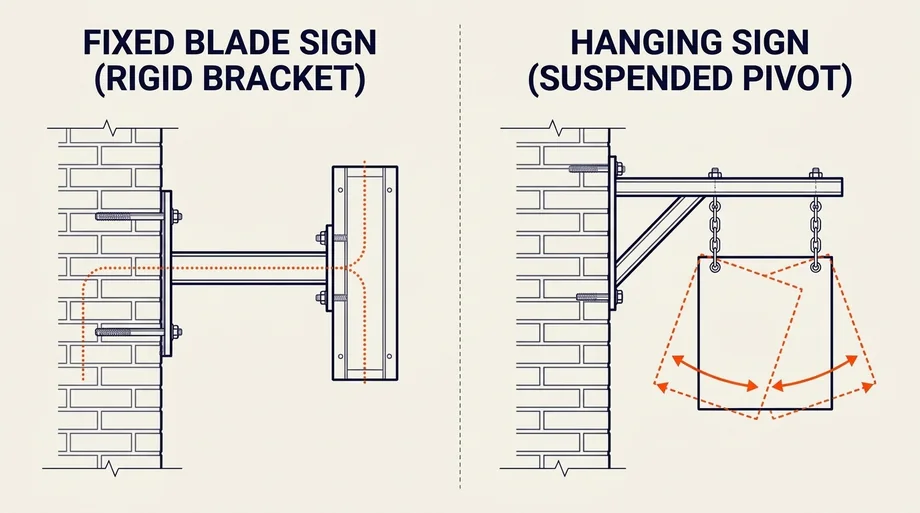
In commercial architecture, a blade sign is a rigid sign assembly mounted perpendicular to a building façade so its two faces run counter to the flow of sidewalk and street traffic. While buyers often use the terms blade sign, projecting sign, flag-mount sign, and bracket sign interchangeably, sign fabricators make an important structural distinction between a fixed blade sign and a hanging sign:
- Custom Blade & Projecting Business Signs: The sign cabinet or panel is rigidly secured to a wall-mounted steel or aluminum armature, or bolted directly via an integrated structural flange. The sign does not swing in the wind, making it easier to seal internal electrical wiring for LED illumination and engineer for higher wind corridors.
- Custom Hanging Business Signs: The sign panel suspends from an overhead scroll bracket, cantilever arm, or soffit ceiling mount using chains, eye-bolts, or clevis pins. Because hanging signs have a pivot point unless stabilized by lower guy-wires, they are typically lighter panels or sheltered arcade and interior wayfinding elements.
When a blade sign is the right tool — and when it isn’t
A projecting sign earns its investment wherever prospects travel parallel to your building face:
- Walkable urban retail corridors and downtown main streets where parked cars, street trees, or neighboring awnings block angled views of flush wall signs.
- Mixed-use developments, arcades, and covered walkways where storefronts sit recessed behind structural colonnades.
- Restaurants, cafés, pubs, and hospitality venues where an evening glow down the block signals that the venue is open.
- Multi-tenant corridors and medical or office plazas where visitors need immediate directional confirmation of a suite entrance.
When another sign type is better: If your business sits back from a multi-lane arterial road and customers arrive almost exclusively by car into a private parking lot, a compact pedestrian blade sign will not provide the letter height required for 35 to 50 mph vehicular recognition. In that scenario, pair primary Custom Illuminated Channel Letter Signs on the façade with Custom Monument & Freestanding Business Signs at the property entrance.
Main types of commercial blade signs
Not every storefront needs — or is permitted to install — an internally lit cabinet. Your operating hours, municipal zoning code, façade substrate, and brand aesthetic determine which configuration fits best.
1. Custom non-lit projecting blade signs
A Custom Non-Lit Projecting Blade Sign uses a solid fabricated aluminum panel, laser-cut metal plate, or architectural core mounted to a structural wall bracket, finished with commercial powder coating and either high-performance vinyl graphics or raised dimensional lettering.
- Best for: Daytime retail boutiques, professional offices, cafés closing before sunset, and strict historic preservation districts that prohibit internal illumination.
- Advantages: Lower fabrication complexity, slim profile, zero electrical hookup requirements, and minimal ongoing maintenance.
- Trade-offs: Relies on ambient street lighting or external architectural fixtures after dark.
2. LED-illuminated blade signs (cabinet style)
An LED-Illuminated Blade Sign features a custom-fabricated aluminum cabinet housing commercial LED modules and enclosed low-voltage power supplies behind translucent acrylic or polycarbonate faces on both sides. For comparable flush-mounted options, see our Custom LED Lightbox & Cabinet Signs.
- Best for: Restaurants, bars, pharmacies, clinics, and evening retail requiring 24-hour legibility.
- Advantages: High contrast and readability day and night; protects internal electrical components inside a weather-sealed enclosure.
- Trade-offs: Requires licensed electrical hookup at the façade penetration point and sufficient cabinet depth to diffuse LED light evenly without hot spots.
3. Push-through acrylic & 3D dimensional blade signs
For brands that want night visibility without a full glowing white cabinet face, fabricators combine blade sign geometry with Custom Push-Through Illuminated Signs or Custom 3D Dimensional Letter Signs. Aluminum faces are CNC-routed so thick acrylic letters push through the metal surface — illuminating only the typography and logo edges while the cabinet background remains opaque. Larger projecting assemblies can also mount individual Custom Illuminated Channel Letter Signs vertically onto a projecting structural spine.
- Best for: Upscale hospitality, flagship retail, architectural developments, and landlords with strict opaque-background sign criteria.
- Advantages: High architectural refinement during daylight and crisp, glare-free halo or edge-lit typography at night.
- Trade-offs: Higher fabrication labor and tighter CNC routing tolerances than flat-face cabinets.
4. Laser-cut metal & custom LED neon blade signs
- Custom Laser-Cut Metal Business Signs: Precision-cut aluminum or steel panels — either non-lit with stencil-cut negative space or paired with an internal acrylic diffuser core for subtle backlighting.
- Custom Neon Signs for Businesses: Weather-rated LED faux-neon or glass neon mounted to a projecting aluminum backer or open frame, frequently selected by bars, cafés, and hospitality venues seeking distinctive evening character.
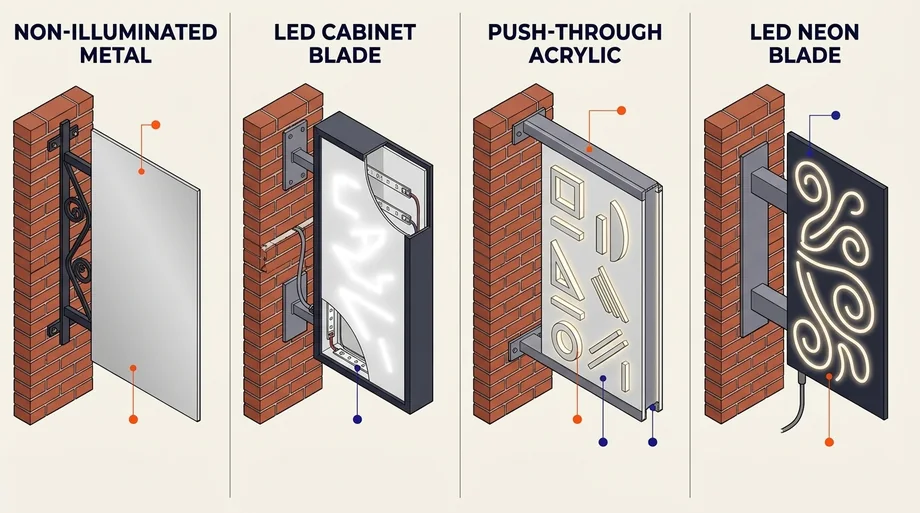
Comparison of commercial blade sign configurations
| Configuration | Primary use case | Night visibility | Electrical required | Relative fabrication scope |
|---|---|---|---|---|
| Non-illuminated metal / panel blade | Daytime boutiques, historic districts, covered arcades | Ambient or external spot only | No (unless adding external lamps) | Low — simplest fabrication & fastest install |
| Double-sided LED cabinet blade | Restaurants, evening retail, clinics, urban storefronts | Full-face double-sided glow | Yes — primary power to internal LED driver | Moderate — sealed cabinet, internal LEDs & faces |
| Push-through acrylic / routed face blade | Premium retail, hotels, landlord-restricted plazas | Letters & logo glow; cabinet stays opaque | Yes — internal LED matrix behind routed face | Moderate–High — CNC routing & thick acrylic inlay |
| 3D channel letter / vertical spine blade | Corner buildings, entertainment venues, anchor tenants | High-output front-lit or halo-lit 3D letters | Yes — raceway or spine-concealed wiring | High — custom structural frame & individual letters |
| Exterior LED neon projecting blade | Bars, cafés, hospitality, photo-driven districts | Continuous neon contour glow | Yes — outdoor-rated low-voltage power supply | Moderate — custom neon channel routing & backer |
How commercial blade signs are built: what separates factory quality from reseller shortcuts
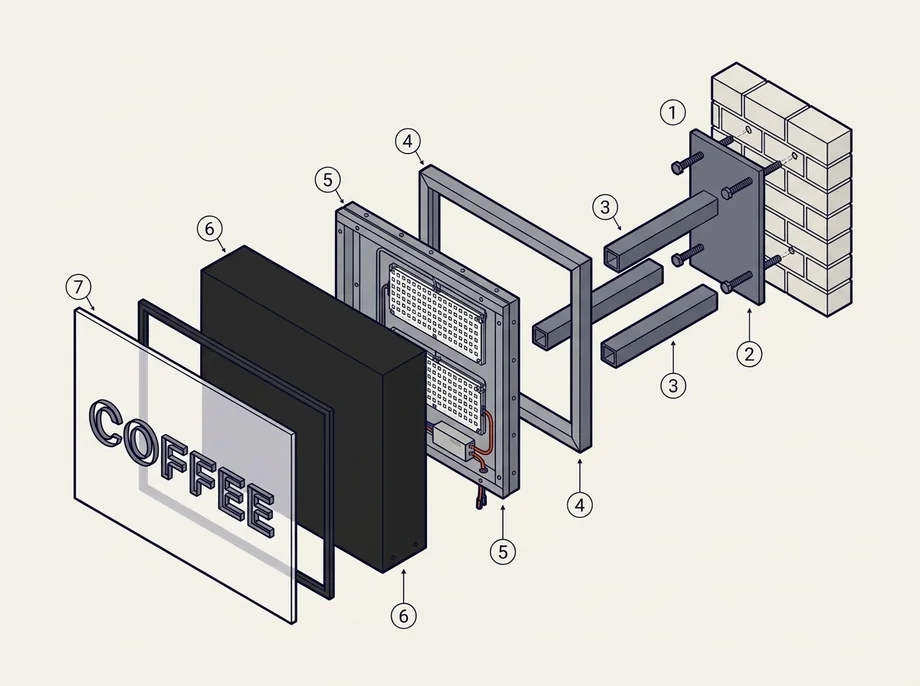
Because a blade sign extends over a walkway exposed to crosswinds, rain, thermal expansion, and vibration, internal construction dictates whether the sign remains safe and legible or develops rust streaks, flickering LEDs, and face warpage. As a factory-direct manufacturer (“We build them. We do not resell.”), UrbanSign Works evaluates blade signs across six engineering checkpoints:
1. Cabinet metals & internal framing
An exterior projecting cabinet should be fabricated from corrosion-resistant aluminum sheet and structural extrusions rather than untreated mild sheet steel or unreinforced plastic. Mild steel oxidizes around fastener penetrations, sending rust stains down masonry or stucco façades. For larger projections, the outer aluminum skin should not carry the wind load alone; an internal welded aluminum or steel frame transfers load directly to the mounting bracket. Specific metal thicknesses and structural profiles are matched to your sign’s dimensions during the quote and shop-drawing stage.
2. Face materials: acrylic vs. polycarbonate
- Sign-grade acrylic: Delivers superior optical clarity, crisp light transmission, and strong resistance to UV yellowing, making it the standard choice for most illuminated retail and restaurant blade signs.
- Polycarbonate: Offers substantially higher impact resistance in areas prone to vandalism, hail, or low-hanging street hazards, though it costs more, scratches more easily during abrasive cleaning, and requires UV-protective grading for prolonged sun exposure.
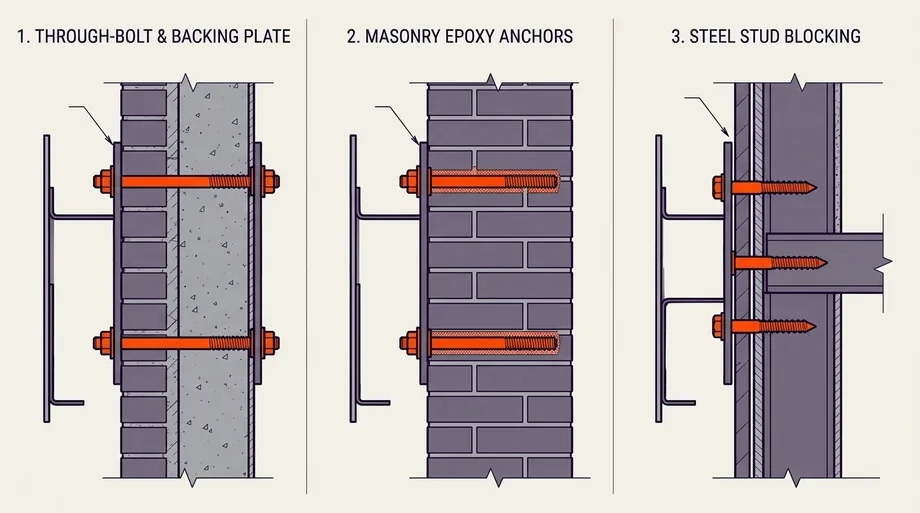
3. Structural bracket engineering & substrate anchoring
A double-sided 3-foot by 4-foot blade sign presents twelve square feet of surface area to wind gusts funneling down an urban street corridor. The mounting system must be designed for both gravity shear and rotational pull-out forces:
- Through-bolting with interior backing plates provides the highest pull-out resistance wherever the interior wall cavity is accessible.
- Chemical epoxy anchors or heavy masonry expansion anchors are used for solid brick, concrete, or structural CMU block — anchored into the solid masonry units rather than mortar joints.
- Structural steel stud or timber blocking attachment is mandatory behind EIFS (synthetic stucco), fiber-cement siding, or metal wall panels; fastening a projecting sign exclusively to exterior sheathing with light-duty toggles is a severe safety hazard.
4. LED module layout & power supply headroom
When an illuminated blade sign develops dark bands (“hot spotting” or “tiger striping”) or fails early, the cause is usually spacing single-sided LED modules too far apart inside a narrow cabinet, or running budget power supplies at maximum capacity inside a sun-heated enclosure. Commercial fabrication pairs optical-lens or double-sided beam-angle LED modules calibrated to the cabinet depth with enclosed, weather-rated power supplies sized with safe load headroom. Exact electrical ratings and component specifications are documented on your project specification sheet.
5. Weather sealing & weep-hole drainage
No outdoor electrical enclosure should trap condensation. While removable retainer frames and electrical entry points must be sealed against wind-driven rain, the bottom return of an exterior blade sign cabinet requires discrete weep holes (drainage vents). Without bottom drainage, trapped moisture corrodes LED connections, fogs internal acrylic faces, and accelerates power-supply failure.
6. Surface prep & powder-coat finishes
Standard wet paint applied over unprimed metal chalks and peels under UV radiation and coastal salt air. Commercial aluminum cabinets and steel mounting brackets require thorough mechanical and chemical surface preparation followed by an exterior-grade baked powder-coat or industrial polyurethane finish. If your storefront is in a coastal or high-salinity environment, flag that during your brief so hardware and finish specifications can be adjusted accordingly.
Sizing, viewing distance, clearance & local permits
Ordering a blade sign based solely on what looks balanced on a computer monitor is one of the most common storefront mistakes. Your sign must be proportioned for the street corridor and compliant with local right-of-way codes.
1. Sizing for approach distance
A practical planning benchmark for commercial legibility is 1 inch (2.5 cm) of letter height for every 10 feet (3 meters)of intended viewing distance, assuming high color contrast and clean letterforms:
| Target viewing distance | Minimum recommended primary copy height | Typical blade sign application |
|---|---|---|
| 50 ft (15 m) | 5 inches | Pedestrian-only arcades, narrow historic lanes, interior mall corridors |
| 100 ft (30 m) | 10 inches | Standard downtown sidewalks, main-street retail, café rows |
| 150 ft (45 m) | 15 inches | Wide urban boulevards, corner storefronts, slow-moving city traffic |
| 200+ ft (60+ m) | 20 inches or taller | Multi-story vertical blade signs, theater districts, arterial approaches |
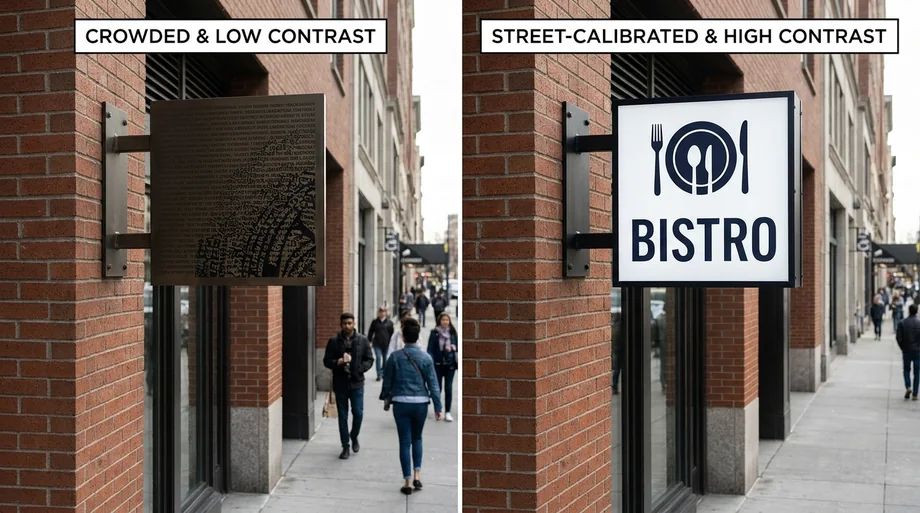
Design takeaway: Because a projecting sign is constrained in horizontal projection (often limited by municipal code to 24 to 48 inches from the wall), secondary taglines, phone numbers, and website URLs clutter the face and reduce readability. Dedicate the sign face to your primary brand name, a recognizable icon, or a concise category word (such as COFFEE, BAKERY, OPTICAL, or CLINIC).
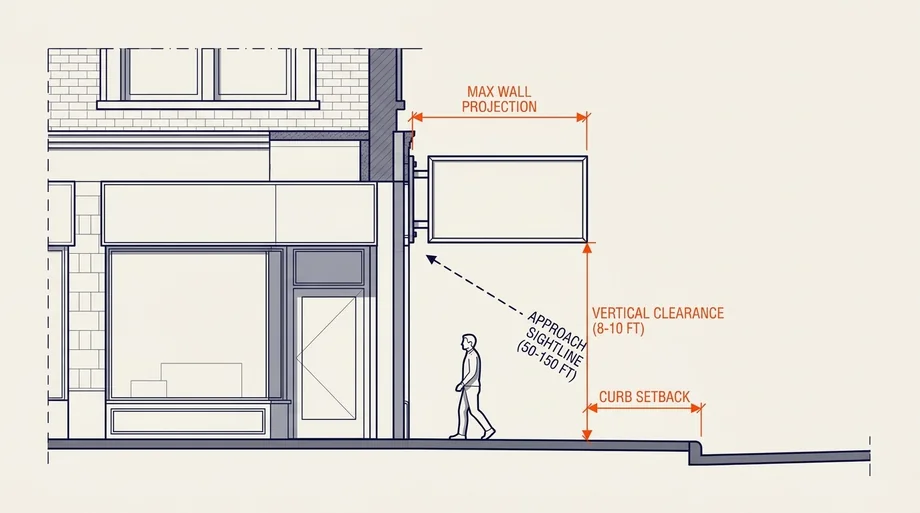
2. Vertical pedestrian clearance & protruding-object rules
Because a blade sign projects over a walkway, its lowest edge must clear pedestrians, maintenance equipment, and accessibility paths:
- Local municipal & building codes: Across jurisdictions in the United States, Europe, and Australia, local sign ordinances regulate minimum vertical clearance from the sidewalk grade to the bottom of the sign (commonly ranging from 8 to 10 feet / 2.4 to 3.0 meters, though exact legal minimums vary by municipality), maximum projection distance from the building wall, and minimum setback from the street curb line.
- Accessibility standards (U.S. context): In the United States, the U.S. Access Board / ADA Standards for Accessible Design (Section 307 — Protruding Objects) stipulate that objects mounted on walls along circulation paths cannot protrude more than 4 inches (100 mm) into the path when their leading edges are located between 27 inches (685 mm) and 80 inches (2030 mm) above the finished floor or ground. Commercial projecting signs must therefore be mounted well above the 80-inch protruding-object zone and satisfy the stricter municipal overhead clearance requirement.
Compliance & Engineering Notice: Sign ordinances, historic district rules, structural wind-load requirements, and electrical codes vary by city, state, and country. UrbanSign Works provides detailed fabrication drawings and specifications to assist your approval process, but does not provide legal code consulting, sealed structural engineering calculations, or municipal permit filing unless expressly contracted in writing. Always verify exact projection, area, and clearance limits with your local building department and licensed local installer prior to final fabrication sign-off.
3. Landlord & historic district approvals
If you lease your commercial space, your lease agreement typically requires written landlord approval covering both the aesthetic design and the exact wall-anchoring method before any penetrations are drilled into the façade. In designated historic districts, an architectural review board may also regulate sign materials, bracket styling, illumination methods, and paint finishes. Obtain landlord and municipal sign criteria early so your 3D mockup can be engineered around those boundaries from day one.
What drives the cost of a custom blade sign?
Blade sign fabrication from $350 per sign, to your approved design — the structural bracket, crating and freight, municipal permit, electrical work and installation are separate local scope.
For the full cost picture, see our business sign cost guide.
When business owners compare blade sign quotes, they often encounter wide price variations for signs that look similar on paper. Understanding the underlying cost drivers and supplier models ensures you compare quotes on an equal specification basis.
1. Core fabrication variables
Because commercial blade signs are built to order around your storefront architecture, pricing depends on four primary specification choices:
- Overall dimensions & projection leverage: Larger cabinets require heavier internal structural skeletons, thicker wall mounting plates, and reinforced brackets to resist wind torque.
- Illumination architecture: Non-illuminated panels are the most straightforward to fabricate; internal LED cabinets represent a mid-tier investment; CNC-routed push-through acrylic faces, custom contour shapes, and 3D channel letters mounted to a projecting spine involve higher machining and assembly labor.
- Materials & finish treatments: Custom color-matched powder coating, brushed metal laminates, multi-layer dimensional acrylic appliqués, or impact-resistant polycarbonate faces adjust material and finishing scope.
- Bracket engineering: A standard straight-arm T-bracket or direct wall flange is more economical than a custom architectural scroll bracket, corner-wrap mount, or heavy-duty cantilever assembly.
2. Comparing fabrication quotes vs. turnkey installed quotes
When evaluating competing proposals, always separate manufacturing scope from local site work:
- Factory fabrication scope: Covers design translation, 3D mockup visualization, fabrication shop drawings, material sourcing, manufacturing, quality-control testing, protective crating, and insured freight delivery.
- Site & local trade scope: Covers municipal sign permit applications, local engineering stamps (where required by municipal wind codes), primary electrical wiring to the façade penetration point by a licensed electrician, and physical wall mounting.
3. Why factory-direct accountability matters
Many local print shops, sign brokers, and agencies operate as resellers: they take your order, mark up a wholesale fabricator’s quote, and act as a middleman.
At UrbanSign Works, “We build them. We do not resell.” Buying through a factory-direct production model gives you:
- Direct technical clarity: Questions about cabinet depth, LED light diffusion, weep-hole drainage, and bracket plate geometry are answered directly by the manufacturing team building your sign.
- Visual proof before production: We provide a free 3D mockup targeted within two business days of receiving a complete project brief, showing how your blade sign will look scaled to your building photo before you commit to fabrication.
- Defined production timelines: Once you approve the final design and specification, fabrication begins, backed by a qualifying 2-year manufacturing warranty (subject to written warranty terms).
- Service across the U.S., Europe & Australia: We coordinate insured delivery across our primary markets of the United States, Europe, and Australia. Installation is handled by your local licensed contractor — we do not install or coordinate installation.
7 costly blade sign mistakes to avoid
- Designing for a close-up screen instead of a 100-foot sidewalk. Packing a projecting sign with small secondary text, street addresses, or intricate thin-stroke script renders the sign illegible from half a block away. Prioritize bold letterforms and high contrast.
- Treating the wall bracket as an afterthought. Specifying a heavy illuminated cabinet without inspecting what sits behind the exterior façade cladding leads to installation delays or structural hazards. Confirm your wall substrate (brick, concrete, steel stud, wood blocking, or EIFS) during the initial brief.
- Authorizing fabrication before landlord or municipal checkpoints. If your commercial landlord prohibits penetrations into decorative stonework or your city limits projection to 36 inches, a pre-built 48-inch sign becomes a costly remake.
- Forgetting the electrical entry path. An illuminated blade sign requires a primary power feed and concealed conduit entry through or along the mounting wall. Plan the interior junction box and timer or photocell location with your electrician early.
- Accepting sealed outdoor cabinets without weep holes. Always verify that illuminated exterior cabinets include bottom drainage vents so condensation does not pool around internal LEDs and power supplies.
- Selecting low-contrast color pairings. Dark lettering on a dark cabinet background disappears in evening shadows unless paired with halo illumination or a high-contrast border.
- Using an unstabilized swinging sign in a high-wind corridor. In windy street canyons or exposed coastal zones, swinging hanging signs experience hardware fatigue; specify a rigid, multi-point bracketed blade sign instead.
Pre-approval checklist: 10 checks before you sign off on a blade sign drawing
Review and check off these ten items on your 3D mockup, technical drawing, and written quote before authorizing fabrication:
- Viewing distance & letter height: Is the primary copy sized for your actual sidewalk approach distance (approximately 1 inch of letter height per 10 feet) with strong figure-ground contrast?
- Cabinet & frame material: Does the specification call for corrosion-resistant fabricated aluminum (with an internal structural skeleton for larger cabinets) rather than mild steel or unreinforced plastic?
- Face material selection: Are the sign faces matched to your operating environment (optical-grade acrylic for standard illuminated clarity, or polycarbonate where impact resistance is needed)?
- LED & power supply specification: For illuminated signs, are commercial LED modules paired with enclosed low-voltage drivers sized with safe operating headroom?
- Weather sealing & drainage: Does the cabinet design include gasketed retainers, sealed electrical entries, and bottom drainage weep holes?
- Bracket & substrate compatibility: Is the mounting bracket plate and anchor strategy matched to your actual building wall material (masonry, concrete, structural steel stud blocking, etc.)?
- Vertical clearance & projection limits: Does the planned mounting height clear pedestrians and satisfy both local municipal sign ordinances and applicable protruding-object accessibility rules?
- Written landlord & historic sign-off: Have you secured written approval from your property owner or landlord (and historic review board, if applicable) for the dimensions, lighting, and wall attachment?
- Electrical access plan: If ordering an illuminated or LED neon blade sign, have you confirmed how a licensed electrician will route primary power to the mounting location?
- Written scope transparency: Does the quote clearly distinguish factory fabrication, 3D mockup, warranty terms, freight delivery, local permits and site electrical work?
From brief to your door.
- Brief: send your site details and design brief.
- Free 3D mockup: targeted within two business days of a complete brief.
- Approve your design.
- Fabrication: 15 business days.
- Delivery within 7 days; installation by your local licensed contractor.
Frequently asked questions
What is the difference between a blade sign and a projecting sign?
In commercial signage, blade sign and projecting sign describe the same sign family: a double-sided sign mounted perpendicular (at a 90-degree angle) to a building façade so oncoming pedestrian and street traffic can read it from both directions. Some architects use blade sign to describe slim, continuous-flange panels and projecting sign for deeper bracket-mounted cabinets, but both fulfill the same street-visibility role.
How high off the ground should an outdoor blade sign be mounted?
Mounting height is governed by your local municipal sign code and pedestrian safety regulations. Many municipalities require a minimum vertical clearance of 8 to 10 feet (2.4 to 3.0 meters) from the sidewalk surface to the lowest edge of the sign or bracket, and in the United States, ADA protruding-object rules (Section 307) restrict wall-mounted objects from protruding more than 4 inches into circulation paths between 27 and 80 inches above the ground. Always verify the exact clearance requirement with your local building authority before installation.
Do I need a city permit to install a storefront blade sign?
In most municipalities across the United States, Europe, and Australia, yes. Local authorities typically regulate outdoor projecting signs for maximum square footage, projection distance from the wall, vertical sidewalk clearance, curb setback, and illumination. Historic districts frequently require an additional architectural review. Because permitting is often the longest lead-time item on a storefront project, begin your local permit check as soon as you receive your initial design mockup and dimension spec. See our FAQ for more.
Should I choose an illuminated or non-illuminated blade sign?
Choose an LED-illuminated blade sign if your business operates after sunset, sits beneath a shadowed arcade or awning, or competes for evening foot traffic in a dining and retail district. Choose a non-illuminated blade sign if your business operates strictly during daytime hours, if your façade lacks a viable route for electrical wiring, or if local historic preservation codes prohibit internal illumination.
How does UrbanSign Works handle shipping and installation?
UrbanSign Works manufactures custom commercial signs through a factory-direct production model serving businesses across the United States, Europe, and Australia. Signs are shipped in reinforced commercial packaging with technical specification drawings. Installation is handled by your local licensed contractor — we do not install or coordinate installation.
See your blade sign on your storefront before we build it
You should not have to guess how a 36-inch projecting sign will look against your brick column or storefront fascia. Whether your project calls for a clean non-illuminated metal blade sign, a double-sided LED-illuminated blade cabinet, or a custom push-through acrylic blade sign, our team helps you verify proportions, materials, and mounting details before fabrication begins.
- Send your storefront brief: Share a daytime photo of your mounting wall or column, approximate available dimensions, your logo file (vector .AI, .EPS, .SVG, or .PDF preferred), and your lighting preference.
- Review your 3D visualization & scope: We deliver a free 3D mockup targeted within two business days of receiving a complete brief, paired with material recommendations and a transparent fabrication quote.
- Approve & build: After you approve the final design and specification, fabrication begins, backed by our qualifying 2-year manufacturing warranty (subject to written warranty terms). Freight delivery, local permitting and primary electrical hookup are clearly separated so you have full visibility into total project scope.
The bottom line
A blade sign earns its keep when the bracket is engineered for the wall, the letters are sized for the approach distance, and the clearance is checked before fabrication — not after. Get those three decisions right and the sign does its job from both directions down the block.
As a factory-direct manufacturer, we build every sign we sell and ship it ready for installation by your local licensed contractor — we do not install or coordinate installation. Every sign is covered by our two-year manufacturing warranty on qualifying products, subject to the written warranty terms, and shipped with free nationwide delivery across the United States and insured freight delivery to Europe and Australia.
Explore Custom Blade & Projecting Signs →
Prefer to discuss your storefront specifications directly? Email info@urbansignworks.com or call +1(337)3503804 (Perpetual Works LLC DBA UrbanSign Works · 30 N Gould St Ste R, Sheridan, WY 82801, USA).