
A shopper walking down a busy street is scanning for a name, a logo, or any clue that tells them where to go. A flat sign fixed to your wall stays hidden until they are standing right in front of it. A blade sign fixes that by turning the sign sideways to the street so people can read it from far down the block.
This guide explains what a blade sign is, the main types, and which outdoor materials last. It also covers design, placement, permits, and the choice between a local sign shop and a factory-direct manufacturer.
What Is a Blade Sign? (What Is Blade Signage?)
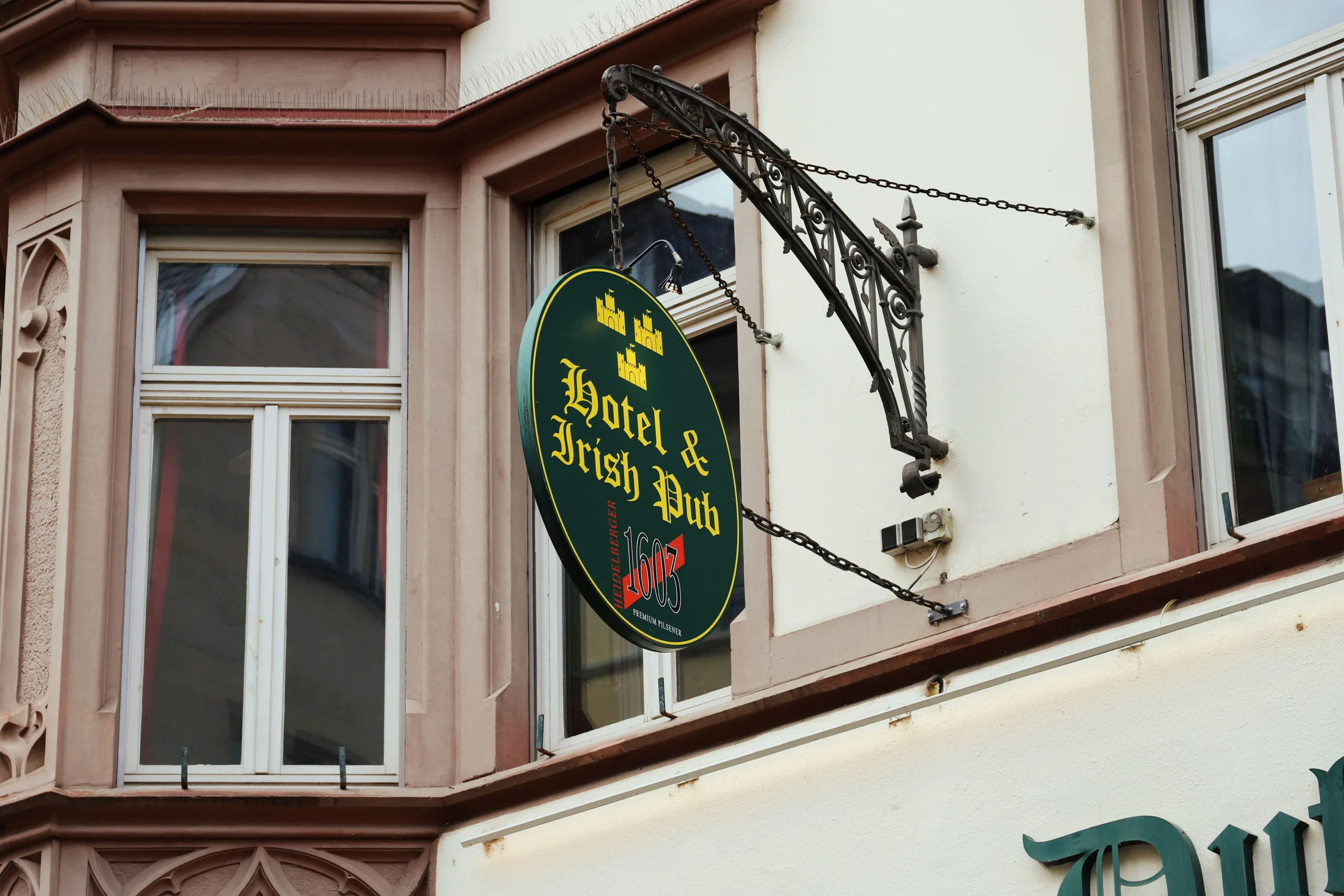
A blade sign is a double-sided sign mounted at a right angle to a building wall or post, so it projects out over the sidewalk. Because it faces oncoming foot and street traffic instead of sitting flat on the facade, people can read it from a distance and from both directions.
If you have ever asked, “What is blade signage?”, think of it as the family of projecting signs that stick out from a storefront like a flag or, as the name suggests, a blade. You may also hear them called projecting signs, flag signs, or bracket signs. The names overlap, and sign makers often use them loosely.
It helps to separate a blade sign from its neighbors:
- Wall sign — lies flat against the building; best read straight on.
- Hanging sign — usually dangles from a bracket, canopy, or ceiling, often swinging on chains; tends to be lighter.
- Blade sign — fixed more rigidly to a wall bracket or post, so it can carry heavier materials and illumination.
In practice, the best choice depends on your street, your building, and how people approach your door. For a deeper look at the lighter alternative, see our hanging signs.
Why a Blade Sign Gets Noticed From Both Directions
Most storefront signage is designed for people standing across the street or directly in front of the shop. Pedestrians do not move that way. They walk along the sidewalk, looking ahead, and their sightline runs parallel to the buildings. A flat sign sits outside that line of sight until the last moment. A blade sign sits inside it.
Because it projects outward, it appears in a walker’s field of view several storefronts away. Drivers moving slowly through a downtown strip or shopping district get the same benefit. This is why a blade sign works so well on narrow frontages, in shared walkways, and on streets where awnings or trees block flat signs.
The idea is not new. In medieval Britain, many people could not read, so shops and inns hung painted symbols out over the street. A red lion or a golden key told the story faster than a name could. Today the symbols have become logos, but the logic holds: a sign that faces the traveler beats one that does not.
A good blade sign also supports your main fascia sign rather than replacing it. The wall sign handles the view from across the road. The blade sign handles everyone walking by.
Types of Blade Signs
Not every business needs the same build. Here are the main types we see most often, and where each one fits.
Non-Illuminated Blade Signs
These are the simplest and most affordable. A flat panel or cut-out shape, usually aluminum or acrylic, is hung from a bracket and printed or painted with your logo. They suit daytime businesses such as boutiques, salons, and offices. With no wiring involved, installation is easier, and upkeep is lower.
LED Illuminated Blade Signs
An LED lightbox blade sign glows from within, so it stays readable after dark. It is a strong choice for restaurants, bars, and anything that trades in the evening. Modern LEDs use little power and last for years. If you want to explore the lighting side, see our LED signs and illuminated signs for businesses.
Channel Letter and 3D Dimensional Blade Signs
Here, the lettering stands out from the sign body. Channel letters are hollow and lit from inside, giving a clean, premium look. Non-lit dimensional letters add depth through shadow rather than light. Both work well when you want the name to feel crafted rather than printed. Learn more about channel letter signs and dimensional signs.
Neon and LED Neon Blade Signs
A neon-style blade sign adds warmth and personality. Traditional glass neon has a classic glow, while LED neon flex is lighter, tougher, and easier to maintain outdoors. For most street-facing projects, we recommend LED neon for its durability. Our neon signs page shows the options.
Custom Shape and Hanging Blade Signs
A sign shaped like a coffee cup, a key, or a tooth is memorable in seconds. Custom outlines can be cut from metal or acrylic. If you prefer a softer, swinging look under a canopy or arcade, a hanging business sign may be the better fit.
You can also combine styles. A metal blade with halo-lit letters, for example, gives a daytime look and a nighttime look in a single sign. Mixing methods is common, and a good manufacturer will show you how each choice changes weight, lighting, and bracket requirements before production starts.
Outdoor Blade Sign: Materials and Weather Durability
An outdoor blade sign hangs in the weather all year, so material choice matters more than style.
- Aluminum is the workhorse. Light, rust-resistant, and takes powder coating well, which protects color against UV fading. Most commercial blade signs use aluminum for both the cabinet and the bracket.
- Stainless steel costs more but resists corrosion in coastal or humid areas, where salt air can damage lesser metals.
- Acrylic is common for faces and letters. Clear, strong, and can be backlit evenly. Choose cast acrylic with UV stabilizers so it does not yellow over time.
- HDU and treated wood give a handcrafted, traditional feel. They suit heritage districts and boutiques, but they need sealing and regular upkeep to last outdoors.
Beyond materials, two technical details deserve attention:
- Wind load. A blade sign acts like a small sail, so the bracket, wall anchors, and sign weight must be engineered for local wind conditions.
- Sealing. Illuminated signs need weatherproof LED modules and sealed seams, ideally with a high ingress protection rating, so rain and dust stay out.
A sign that looks perfect on day one but leaks in month six is a poor investment. Ask your supplier what coating, LED rating, and warranty come with the sign. Clear answers are a good indicator of real manufacturing experience.
Signage Blade Design Tips That Improve Readability
A signage blade has very little space and very little time. Someone walking past gives it two or three seconds. These rules help you make the most of them.
- Lead with the logo and name. Skip the slogan, phone number, and opening hours. If it cannot be read in a glance, remove it.
- Use strong contrast. Light letters on a dark background, or the reverse, are readable at a distance. Avoid thin scripts and low-contrast pastels.
- Keep text large. Taller letters read from farther away. Design for the longest distance at which a pedestrian will first see the sign, not the closest.
- Use a simple icon. A symbol or silhouette is processed faster than words and works across languages.
- Design both faces. Since a blade sign is seen from two directions, both sides should carry the brand. Check that text reads correctly on each face and that mounting hardware does not cover key details.
- Match your brand. Use exact brand colors so the sign looks consistent with your fascia, menu, and website. Pantone matching keeps color accurate from sign to sign.
- Think about lighting. If your street is dim, plan for illumination early. Adding it later usually means rewiring and a new cabinet.
- Preview before building. A 3D mockup placed on a photo of your actual building shows proportions and color far better than a flat drawing. We provide a free mockup before fabrication for exactly this reason — request yours here.
Blade Sign Size, Mounting Height and Permit Basics
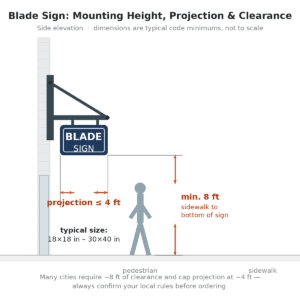
Size and placement are where many projects go wrong, so check them early.
- Size. Typical storefront blade signs range from about 18 by 18 inches up to roughly 30 by 40 inches, though shape and building scale change that. Bigger is not always better — a sign that overwhelms the facade can break local rules or look out of place.
- Mounting height. Many municipal codes require a minimum clearance of around 8 feet between the sidewalk and the bottom edge of a projecting sign, and some require more. Mount it high enough to clear heads and delivery traffic, but low enough to be read comfortably as people approach.
- Projection. Codes often limit how far a sign can extend from the wall. Four feet is a common ceiling, but this varies by city, so always confirm locally.
- Placement. Position the sign near the entrance, on the side where most pedestrians approach. Leave space from awnings, trees, street lamps, and neighboring signs so nothing blocks the view. On a street with several blade signs, clear spacing keeps yours from getting lost in the crowd.
- Structure. The wall must support the load. Brick, concrete, and steel framing usually do. Thin cladding or old masonry may need reinforcement behind the bracket.
- Permits. Most cities require a permit for a projecting sign, and some districts add design review. Landlords may also set their own rules. Requirements change by location, so check with your local planning department and your property manager before ordering. We help customers prepare specifications and drawings, but approval always comes from the local authority.
Which Businesses Benefit Most From a Blade Sign?
A blade sign suits any business that relies on walk-in customers:
- Restaurants and cafes use illuminated or neon-style signs to pull in evening foot traffic.
- Retail shops use them to stand out on crowded shopping streets.
- Clinics and dental offices use clean, simple blades to make entrances easy to find.
- Hotels and boutique stays use elegant metal or channel letter designs to signal quality.
- Multi-tenant buildings use them so each tenant stays visible, even when the facade is shared.
Businesses set back from the main road or tucked onto side streets often gain the most, because a blade sign makes a hidden entrance visible. Wherever you operate, ask one question: does a person walking past see my name before they pass my door?
Blade Signs Near Me: Local Shop or Factory-Direct Manufacturer?
Many buyers type “blade signs near me” into a search bar, and that makes sense. A local shop can visit your site, measure the wall, and handle installation. For a single sign in a city with a good installer, that can be very convenient.
The trade-off is price and flexibility. Many local shops act as middlemen. They order from a fabricator, add their margin, and pass the lead time on to you. Your options may be limited to what they usually sell.
A factory-direct manufacturer like UrbanSign Works builds the sign itself. That removes broker markups and gives you direct control over materials, finishes, and Pantone color matching. We offer a free 3D mockup, 15-day fabrication after design approval, a two-year manufacturing warranty, and insured worldwide shipping, so we can deliver to the US, UK, Australia, the Middle East, and beyond.
Installation is the one area where local help still matters. We provide installation guidance and can coordinate with professionals, and many customers hire a local installer for mounting. This hybrid approach gives you factory pricing and a local pair of hands.
Compare both routes by asking for a written quote, a design preview, warranty terms, and delivery timing. If budget is your main concern, our guide on how much a blade sign costs explains what drives the price.
Common Blade Sign Mistakes to Avoid
Most problems are easy to prevent if you plan ahead:
- Putting too much text on a small face.
- Ordering before checking local size, height, and projection rules.
- Underestimating wind load and using a weak bracket.
- Choosing thin fonts or low-contrast colors.
- Mounting the sign so high it disappears, or so low it becomes a hazard.
- Skipping a mockup and discovering proportion problems after fabrication.
Frequently Asked Questions About Blade Signs
What is a blade sign?
A blade sign is a double-sided sign mounted perpendicular to a building wall or post, projecting over the sidewalk so it can be seen from both directions. It is also called a projecting sign or flag sign, and shops, restaurants, clinics, and offices use it to attract foot traffic.
What is the difference between a blade sign and a hanging sign?
Both project from a building, but a blade sign is typically rigid and fixed to a bracket or post, so it can carry heavier materials and lighting. A hanging sign usually suspends from chains or a ceiling and may swing. Many people use the terms interchangeably, so confirm the specification with your supplier.
How high should a blade sign be mounted?
Many local codes call for about 8 feet of clearance between the pavement and the bottom of the sign, and some require more. The right height also depends on pedestrian traffic, building design, and visibility. Always confirm the exact rule with your city or landlord before installing.
Do I need a permit for an outdoor blade sign?
In most cities, yes. Projecting signs usually require approval because they extend over public or shared space. Rules on size, projection, lighting, and placement vary, so contact your local planning or building department early.
How long does an outdoor blade sign last?
With quality materials, such as powder-coated aluminum, UV-stable acrylic, and sealed LEDs, an outdoor blade sign can serve for many years. Lifespan depends on climate, maintenance, and build quality. Always ask for warranty terms. Ours include a two-year manufacturing warranty.
How much does a blade sign cost?
Pricing depends on size, materials, illumination, bracket engineering, and whether you buy through a local shop or factory-direct. Our pricing guide breaks down what drives the cost.
Get a Free 3D Mockup of Your Blade Sign
A blade sign is one of the most efficient ways to make a storefront visible to people who are already walking past. It works because it faces the traveler instead of the wall. Choose the right type, durable outdoor materials, a readable design, and correct mounting, and it will keep working for years.
Ready to plan yours? Request a free 3D mockup and quote and see your sign on your building before anything is built — or contact us with questions about materials, permits, or installation.