
Channel letters are the three-dimensional illuminated letters you see on storefronts, office buildings, and restaurants — each letter its own self-contained unit with aluminum sides, a translucent or solid face, and lighting inside. They’re the premium standard for commercial building signage, and choosing between the types of channel letters involves real trade-offs in brightness, style, cost, and installation.
This is a purely informational guide: what the types of channel letters are, how channel letters are fabricated, which fonts work (and which cause expensive problems), how the lighting works, and how they’re mounted. If you already know what you want and need pricing, our channel letters signage page covers the buying side.
What Are Channel Letters, Briefly?
Each channel letter is a hollow, three-dimensional letterform — typically 2 to 5 inches deep — built from aluminum “returns” (the sides), with a face that’s either translucent acrylic (for face-lit letters) or solid aluminum (for halo-lit letters). Inside, LED modules provide the illumination; a power supply (usually 12V DC) drives them. Letters mount individually to the wall, to a raceway, or stand off the wall on spacers. All types of channel letters share this basic hollow construction.
The name comes from the channel-like cross-section of each letter. What varies between the types of channel letters is where the light comes out — and that single decision defines the look, the cost, and the installation.
The 4 Main Types of Channel Letters
1. Front-Lit (Standard) Channel Letters
The classic among the types of channel letters. LEDs inside each letter shine forward through a translucent acrylic face, so the letterforms themselves glow. Maximum brightness, maximum readability, day and night.
- Best for: Retail storefronts, restaurants, cafés, strip malls, auto dealers — anywhere stopping traffic matters
- Visibility: Highest of all types of channel letters; readable from the greatest distance
- Cost: The baseline — typically the most economical illuminated option per letter
- Faces: Translucent acrylic or polycarbonate, color-matched to brand specs
2. Halo-Lit (Reverse-Lit) Channel Letters
The letters have solid aluminum faces and open (or translucent) backs. Mounted 1–2 inches off the wall on spacers, LEDs inside wash light backward onto the wall, creating a soft halo glowing around each letterform. The letters themselves stay dark; the wall behind them glows. Among the types of channel letters, halo-lit offers the most sophisticated nighttime appearance.
- Best for: Corporate offices, medical clinics, law firms, hotels, luxury retail, spas — brands selling sophistication
- Visibility: Lower raw brightness, but striking and premium at night
- Cost: Typically 20–40% more than front-lit — solid faces, standoff hardware, more labor
- Requirement: Needs a light-colored wall (or a backer panel) for the halo to read; on dark walls the effect washes out
3. Combination (Front + Halo) Channel Letters
Both at once: translucent faces for direct illumination plus open backs for the halo. The most dramatic of the types of channel letters at night — glowing letterforms floating in their own halo.
- Best for: Flagship retail, high-end restaurants, entertainment venues, corporate headquarters
- Visibility: Maximum impact; the showroom-grade option among types of channel letters
- Cost: The premium tier — essentially two lighting systems in one letter set
4. Open-Face Channel Letters
The traditional theater-marquee style: no face at all, with exposed bulbs or LED “bulbs” visible inside the letter channel. Vintage, high-character, unmistakable. One of the most distinctive types of channel letters for retro and entertainment brands.
- Best for: Theaters, bars, retro restaurants, entertainment venues
- Visibility: High character, moderate raw brightness
- Cost: Moderate, but maintenance is higher — exposed components need periodic attention
- Note: Some jurisdictions restrict exposed-bulb signage; check local codes early
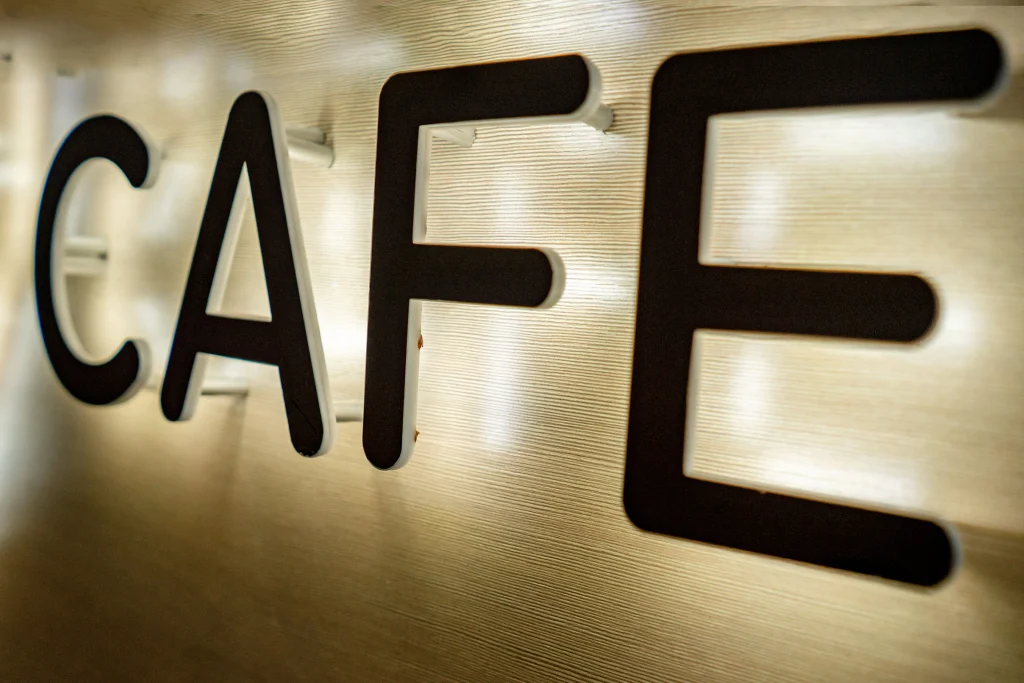
Front-Lit vs. Halo-Lit: Head-to-Head
Here’s how the two most popular types of channel letters compare:
| Factor | Front-Lit | Halo-Lit (Reverse) |
|---|---|---|
| Light direction | Through the face, toward the viewer | Behind the letter, onto the wall |
| Nighttime brightness | Maximum | Soft, ambient |
| Daytime appearance | Colored acrylic faces | Solid metal faces (often brushed aluminum) |
| Brand impression | Bold, high-energy, retail | Premium, understated, corporate |
| Relative cost | Baseline | ~20–40% higher |
| Wall requirement | Any wall color | Light-colored wall or backer panel |
| Energy use | Moderate | Slightly lower (fewer modules) |
| Best viewing distance | Long range | Close to medium range |
How Channel Letters Are Made: The Fabrication Process
Understanding the build helps you evaluate quotes — and spot the shops cutting corners. Here’s the standard commercial process for fabricating all types of channel letters:
- Design & engineering. Your logo is converted to vector artwork; each letter is engineered with proper stroke widths, and a layout is created at exact scale.
- Returns are formed. Flat aluminum sheet (typically 0.063″ / 16-gauge) is cut and bent to form the 3D sides of each letter — the “can.”
- Backs are attached. Aluminum backs close the rear of each letter (except halo-lit, which get open or translucent backs).
- Faces are cut. Translucent acrylic or polycarbonate is CNC-cut to each letterform and fitted with trim cap edging that seals the face to the returns.
- LED modules are laid out. LED modules are positioned inside each letter on a grid calculated for even illumination — no hot spots, no dark zones. Module spacing follows the manufacturer’s photometric specs for the letter depth.
- Wiring. Modules are wired in series/parallel strings back to the power supply location, with weather-sealed connections.
- Power supplies are sized. 12V DC LED drivers are specified with headroom above the calculated load (good shops size at ~80% of driver capacity, not 100%).
- Finishing. Returns are powder-coated or painted to brand colors; faces get UV-stable color.
- Testing & burn-in. The complete set is powered and burned in before it leaves the factory — catching dead modules and wiring faults while they’re still cheap to fix.
- Packing & crating. Letters are individually protected and crated for freight.
Quality markers to ask about: UL-recognized LED modules, IP65 weather rating on modules, enclosed UL-listed power supplies, and silicone-sealed wire entries. Our channel letters page details the commercial-grade build standard — these are the specs worth demanding from any fabricator of the types of channel letters.
Channel Letter Fonts: What Works and What Doesn’t
Typography in channel letters is an engineering problem as much as a design one. The constraints apply across all types of channel letters:
- Minimum stroke width. LED modules need physical space inside the letter. Very thin strokes (hairline serifs, delicate scripts) can’t house modules — the general rule is strokes need roughly 3/4″–1″ minimum width for standard modules, which is why very small or very thin letterforms get redesigned or upsized.
- Sans-serif faces are the safest choice: clean strokes, even widths, excellent legibility at distance.
- Serif fonts work when the serifs and strokes are substantial enough — think bold Clarendons, not delicate Didones.
- Script fonts are possible but expensive: thin connecting strokes often need to be thickened, and fabrication labor rises with every curve.
- Custom logos get redrawn for fabrication — letterforms are slightly modified (stroke weights adjusted, counters opened) so the sign reads correctly at 50 feet, not just on screen.
These typography constraints apply to all types of channel letters, from front-lit to open-face. Rule of thumb: if your logo was designed for print or web, expect your sign fabricator to propose fabrication-adjusted letterforms. That’s normal and correct — it’s the difference between a logo that looks good in a PDF and one that reads from across the parking lot.
Lighting: LED Modules vs. Old-School Neon
Modern types of channel letters are overwhelmingly LED-illuminated — for good reason:
- Lifespan: Quality LED modules are rated 50,000+ hours — roughly 11 years at 12 hours a night. Old neon tubes lasted a fraction of that.
- Energy: LEDs use a fraction of the electricity of neon transformers.
- Durability: No fragile glass tubes, no high-voltage transformers. Sealed LED modules handle weather, vibration, and temperature swings.
- Color: White LEDs behind colored acrylic faces produce clean brand colors; RGB modules enable color-changing effects.
- Color temperature: 6500K daylight white is the standard for crisp face illumination; 3000–4000K warm white suits hospitality and halo applications.
Glass neon still exists for channel letters (true “neon channel letters”), chosen deliberately for its specific warm aesthetic — but for most commercial applications, LED is brighter, cheaper to run, and far more reliable. Our LED signs page covers the technology used across the types of channel letters in more depth.
Mounting Options: Direct, Raceway, and Standoff
How the letters attach to your building matters for cost, appearance, and landlord approval. The mounting method is independent of which of the types of channel letters you choose:
| Method | How it works | Pros | Cons |
|---|---|---|---|
| Direct (flush) mount | Each letter mounts individually to the wall; wiring passes through the wall | Cleanest look; no visible hardware | Multiple wall penetrations; harder to service |
| Raceway mount | Letters mount to a painted aluminum box (raceway) containing all wiring; raceway mounts to wall | One penetration point; fastest install; landlord-friendly | Visible horizontal bar behind letters |
| Standoff mount | Letters stand 1–2″ off the wall on spacers | Required for halo-lit; creates depth | More hardware; higher labor |
Raceway mounting is the practical choice for leased spaces — landlords prefer a single mounting footprint, and removal at lease-end is far simpler. Direct mounting gives the cleanest architectural look for owned buildings, regardless of the types of channel letters installed.
What Do Channel Letters Cost?
Pricing for the different types of channel letters depends on letter count, letter height, type, and mounting — but realistic US ranges as of 2026:
- Small front-lit set (e.g., 8–12 letters, 18″–24″ tall): $1,500–$4,000
- Typical storefront set (12–20 letters, 24″–36″ tall): $3,000–$8,000
- Halo-lit set: add roughly 20–40% over front-lit
- Combination lit: the premium tier, often 50–100% over front-lit
- Raceway: adds $500–$1,500 to the project but simplifies install
The cost drivers, in order: total linear footage of lettering, letter height and depth, lighting type, mounting method, and finish complexity. Factory-direct manufacturing removes the broker markup (typically 40–60% at franchise shops) that inflates most quotes for the types of channel letters. These ranges cover standard configurations; custom shapes and premium finishes for the types of channel letters can exceed them.
Want firm numbers for your storefront? Get a free 3D mockup showing your exact lettering on your building — day and night — with an itemized quote. No commitment until you approve the design.
Choosing the Right Type: A Quick Decision Guide
Use this guide to match your business needs to the right option among the types of channel letters:
- Retail or restaurant on a busy street? Front-lit. Brightness wins customers.
- Office, clinic, or law firm? Halo-lit. The premium signal matches the brand.
- Flagship location or grand opening? Combination. Maximum presence.
- Theater, bar, or retro concept? Open-face. The aesthetic is the point.
- Leased space with a strict landlord? Front-lit on a raceway. Clean install, clean removal.
- Dark building facade? Front-lit — halo effects need a light wall to bounce off.
Frequently Asked Questions About Channel Letter Types
What are the different types of channel letters?
The four main types of channel letters are front-lit (light through the face), halo-lit/reverse-lit (light projected behind the letters onto the wall), combination (both at once), and open-face (exposed bulbs, no face). Mounting varies separately: direct mount, raceway mount, or standoff.
Which type of channel letter is brightest?
Front-lit channel letters are the brightest among the types of channel letters — LEDs shine directly through the translucent face toward the viewer. Combination letters match or exceed them with the added halo effect.
Are halo-lit channel letters worth the extra cost?
For premium-positioned businesses — offices, clinics, hotels, luxury retail — yes. The halo effect signals quality in a way raw brightness can’t, and the solid metal faces look architectural during the day. For pure traffic-stopping visibility, front-lit delivers more brightness per dollar among the types of channel letters.
How long do channel letter LEDs last?
Quality LED modules rated at 50,000+ hours run roughly 11 years at 12 hours per night. Individual modules can be replaced without rebuilding the letter, regardless of which of the types of channel letters you choose.
Can channel letters use my exact brand font?
Usually with fabrication adjustments for the types of channel letters. Your font is redrawn with minimum stroke widths for LED placement and distance legibility. Very thin or delicate typefaces may need a bolder cut of the same family.
Do channel letters need a raceway?
No — raceway mounting is optional for the types of channel letters. Direct wall mounting looks cleaner; raceways simplify wiring, speed installation, and are preferred for leased spaces. Halo-lit letters use standoff mounting instead.
What’s the difference between channel letters and dimensional letters?
Unlike the types of channel letters, dimensional letters are solid, non-illuminated 3D letters — same dimensional look, no internal light (they can be externally lit with spotlights).
See Your Business in Channel Letters Before You Commit
The decision among the types of channel letters gets easy once you see it. Send your logo and a storefront photo, and we’ll render your business in front-lit, halo-lit, or combination letters — day and night — free within 48 hours, with an itemized factory-direct quote.
Start with a free 3D mockup: Request your free quote or contact our signage team. For related reading on the types of channel letters, see our illuminated signs guide and our exterior signage overview.