
Signs and banners are essential tools for businesses that want to attract attention, communicate important information, and create a recognizable presence. From storefront identification to event promotions, custom signs and banners can be designed for different locations, messages, materials, and viewing distances.
For businesses that need outdoor signs and banners, the right combination of material, size, design, mounting method, and placement makes a significant difference. Vinyl banners, aluminum signs, mesh banners, yard signs, and other exterior signage options each have different strengths. This guide explains how to choose an option that fits your business and application.
What Are Signs and Banners?
Signs and banners communicate visually by displaying a business name, logo, promotional message, directions, event information, announcements, or other important information. The main difference lies in their physical construction and intended use:
- Signs often use rigid materials such as aluminum, acrylic, plastic, or other panels.
- Banners generally use flexible printed materials such as vinyl or mesh.
Businesses can use signs and banners indoors or outdoors, but outdoor applications require materials and installation methods that can withstand sunlight, rain, and wind. Vinyl works well for outdoor banners because it offers flexibility, printability, and weather resistance. Mesh banners work especially well in windy locations because their perforated construction allows air to pass through.
Types of Signs and Banners
Choosing the right signage starts with understanding the available options.
1. Outdoor Vinyl Banners
Vinyl banners are among the most versatile options for temporary and semi-permanent outdoor messaging. They can be customized with business names, promotional graphics, event information, phone numbers, websites, and other content. They work well for:
- Grand openings
- Sales and promotions
- Business announcements
- Events
- Construction notices
- Community activities
- Seasonal advertising
- Roadside advertising
2. Mesh Banners
Mesh banners are designed with small perforations that allow air to move through the material. This makes them useful where wind exposure matters — fences, scaffolding wraps, and large outdoor structures. A mesh banner is the practical choice when a solid vinyl banner would catch too much wind.
3. Aluminum Signs
Aluminum signs provide a rigid alternative to flexible banners. They suit business identification, property information, parking areas, and directional messages. Their rigid construction gives a clean, professional appearance where a permanent-looking sign is preferred.
4. Yard Signs
Yard signs are lightweight and easy to install, making them useful for short-term advertising, real estate, political campaigns, events, and local promotions. They are particularly effective when the message needs to be repeated across multiple locations.
5. Pole and Hanging Banners
Pole banners add visibility along streets, commercial properties, campuses, shopping areas, and event venues. They can be arranged in a series to create consistent branding across a property. For double-sided visibility from sidewalks and corridors, purpose-built hanging signs are the rigid alternative.
6. Custom Business Signs
Custom business signs are designed around the identity and physical requirements of a specific company. Instead of a generic template, businesses select the sign type, dimensions, materials, colors, graphics, mounting method, and message. For a storefront, the sign must work with the building facade, surrounding architecture, viewing distance, and existing brand identity.
Vinyl Banner Materials and Finishing: Hemming, Grommets, and Weight
Not all vinyl is equal. Understanding the material and finishing options helps you order banner signs that actually last outdoors.
Vinyl weight (ounces):
- 10 oz vinyl — economical, best for short-term indoor use or sheltered displays.
- 13 oz vinyl — the standard for outdoor banners; a good balance of durability and price.
- 18 oz vinyl — heavy-duty, suited to long-term outdoor installations and high-wind exposure.
Hemming: The edges of a banner are folded over and heat-welded or sewn (hemmed) to prevent fraying and add strength. A hemmed edge dramatically extends banner life, especially outdoors.
Grommets: Metal eyelets (usually brass or nickel, spaced every 2–3 feet) punched through the hemmed edge give you secure attachment points for rope, bungee cords, or zip ties. Without grommets, fasteners tear straight through the vinyl.
Other finishing options:
- Pole pockets — a sewn sleeve along the top and/or bottom that slides over a pole or dowel, common for pole banners and indoor displays.
- Wind slits — half-moon cuts in solid vinyl that let some air pass through. They reduce wind load but can distort graphics; mesh vinyl is usually the better choice for genuinely windy sites.
- Double-sided printing — two banners sewn back-to-back (blockout vinyl between them) so the message reads from both directions without show-through.
Indoor vs. Outdoor Signs and Banners
| Factor | Indoor | Outdoor |
|---|---|---|
| Material priority | Appearance and finish | Weather resistance |
| Typical vinyl | 10–13 oz standard | 13–18 oz, UV-resistant |
| Finishing | Often minimal; pole pockets for displays | Hemmed edges + grommets essential |
| Wind | Not a factor | Mesh or wind-rated mounting required |
| Sunlight | Minimal fading risk | UV-stable inks required |
| Lifespan | Years with light use | Months to a few years, depending on exposure |
| Rigid option | Foam board, PVC | Aluminum, ACP, dibond |
The short version: a banner that lives indoors can prioritize looks, while anything outside must be engineered for sun, rain, and wind from day one.
Signs and Banners for Outdoor Business Use
Outdoor signs and banners have to do more than look attractive. They need to communicate quickly where customers may only have a few seconds to notice them. Before choosing a design, consider:
- Where the sign will be installed
- How far away viewers will be
- Whether people are walking or driving past
- How much time viewers have to read the message
- Whether the sign will be exposed to strong wind
- How long the sign will remain outdoors
- How it will be mounted
- Whether local approval or permits may apply
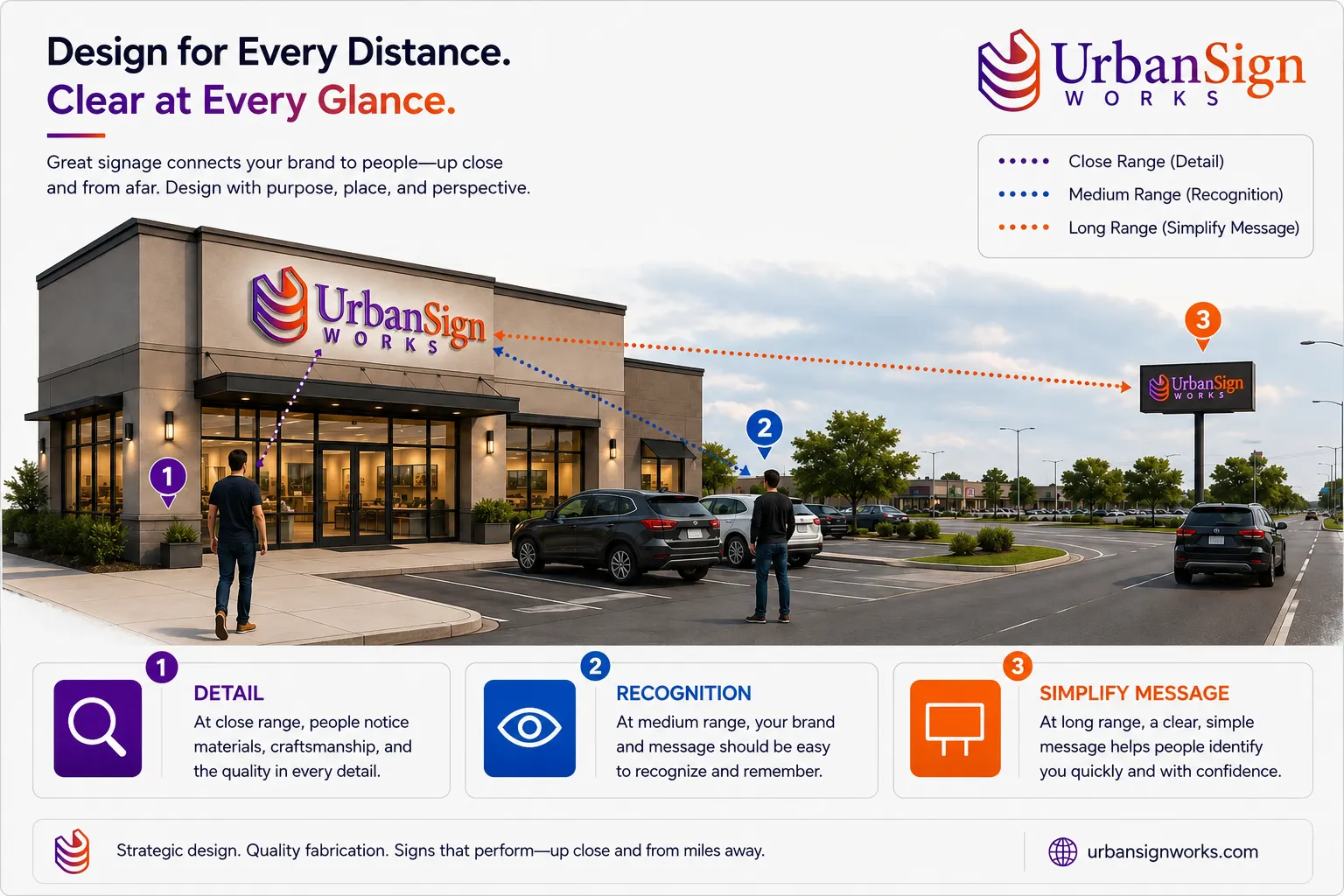
A roadside banner generally needs a simpler message and larger lettering than a sign located directly beside a pedestrian entrance. The viewing environment should influence both the physical sign and its graphic design.
How to Choose the Right Material
| Material | Best suited for | Main consideration |
|---|---|---|
| 13 oz vinyl | Outdoor promotions and banners | Flexible and weather-resistant |
| Mesh vinyl | Wind-exposed locations | Allows air to pass through |
| Aluminum | Rigid outdoor signs | Professional, durable panel format |
| Corrugated plastic | Temporary yard signs | Lightweight and easy to install |
| Fabric | Certain temporary displays | Lightweight appearance and handling |
Signs and Banners Price: What Affects Cost?
Avoid comparing products on finished size alone. Typical US ranges (as of 2026):
| Product | Typical cost range |
|---|---|
| Vinyl banner, 3′×6′, 13 oz, hems + grommets | $60–$150 |
| Mesh banner, 4′×8′ | $80–$200 |
| Aluminum sign, 4′×8′, printed | $150–$400 |
| Yard signs, 24″×18″ (qty 25) | $5–$15 each |
| Pole banner pair with hardware | $200–$500 |
The total cost depends on several project variables:
- Sign or banner dimensions
- Material selection and vinyl weight
- Single- or double-sided printing
- Graphic design requirements
- Finishing options (hems, grommets, pole pockets)
- Mounting hardware and structural requirements
- Installation and site accessibility
- Electrical requirements for illuminated signs
- Permitting or approval requirements
- Shipping or transportation
A simple printed banner and a fabricated illuminated storefront sign can have very different scopes, even if both are described as business signage. A useful quote should clearly identify what is included rather than providing only a single number. If you’d like a scoped estimate for your project, get a free 3D mockup with itemized pricing.
How to Design Effective Signs and Banners
Keep the Main Message Simple
Outdoor viewers should understand the primary message quickly. Instead of trying to communicate everything, prioritize:
- Business name or primary message
- Main offer or purpose
- Essential supporting information
- Call to action, when appropriate
Use Strong Contrast
Text needs sufficient contrast against its background. Colors should also work with the surrounding environment rather than disappearing into it.
Choose Readable Typography
Bold, uncomplicated typefaces are generally easier to read from a distance than decorative fonts. The further away the viewer, the more important letter size, spacing, and contrast become.
Design Around Viewing Distance
A banner beside a sidewalk can use different proportions than one beside a busy road. Think about the viewer’s:
- Distance
- Speed
- Viewing angle
- Available reading time
- Line of sight
Custom Signs and Banners for Different Businesses
Retail Stores
Retailers use banners for sales, new product launches, grand openings, seasonal promotions, and store identification.
Restaurants
Restaurants may use outdoor signage to display business names, menus, special offers, opening announcements, and directional information.
Construction Companies
Construction sites may require temporary signs that identify the project, provide safety information, or communicate site instructions.
Schools and Organizations
Schools, nonprofits, and community organizations use banners for events, announcements, celebrations, and public messages.
Commercial Properties
Property managers use signs for tenant identification, parking information, wayfinding, leasing, and temporary notices — often as part of a monument sign or directory system at the property entrance.
What to Consider for Custom Outdoor Business Signs
Begin with the building and site rather than the artwork alone:
- Building: What surface will support the sign?
- Visibility: From where will customers see it?
- Environment: Is the location exposed to wind, rain, direct sunlight, or traffic?
- Branding: What colors, fonts, and graphics represent the business?
- Installation: Will the sign require posts, brackets, fasteners, a frame, or another mounting system?
- Maintenance: How easily can the sign be cleaned, repaired, replaced, or updated?
- Local requirements: Does the property or jurisdiction have sign regulations to review?
How to Choose a Sign Company
Proximity should not be the only selection criterion. Before choosing a signage company, ask:
- Do they manufacture or outsource the sign?
- Can they recommend materials for your location?
- Do they provide design assistance?
- Can they handle installation?
- What finishing options are available?
- Can they explain the mounting method?
- Do they provide a proof before production?
- Can they help identify site or permitting considerations?
- Is the quote clear about production and installation scope?
A provider that understands your property and installation conditions can identify practical issues before production begins.
Installation and Maintenance
Installation directly affects how a banner performs outdoors. Banners may use grommets, rope, clips, zip ties, bungee cords, pole pockets, or other mounting methods depending on the application. Secure installation reduces unnecessary movement and stress on the material.
For outdoor banners, routine care includes:
- Cleaning with mild soap and water
- Checking mounting points
- Removing excessive dirt or debris
- Inspecting edges for damage
- Storing reusable banners properly
- Removing banners when severe weather creates an unreasonable installation risk
Common Mistakes to Avoid
- Using too much text — a banner is not a brochure.
- Choosing the wrong material — a solid banner on a wind-exposed fence will tear; mesh is the better call.
- Ignoring installation — even a well-designed banner looks unprofessional if poorly mounted.
- Making the design too complicated — too many fonts, colors, and messages reduce clarity.
- Choosing a size without considering viewing distance — dimensions must match where the sign is installed.
A Simple Decision Framework
- Define the purpose — advertising, branding, wayfinding, event promotion, announcement, or identification?
- Identify the location — storefront, wall, fence, roadside, sidewalk, parking area, campus, or event space?
- Determine viewing conditions — pedestrian, vehicle, close-range, or long-distance viewing?
- Evaluate the environment — wind, rain, sunlight, and other exposure.
- Choose the format — flexible banner, rigid sign, mesh banner, yard sign, pole banner, or another solution.
- Build the design — short message, readable typography, strong contrast, consistent branding.
- Confirm installation — mounting hardware, attachment points, access, and site requirements.
- Review the quote — material, dimensions, finishing, installation, and other components clearly defined.
Frequently Asked Questions About Signs and Banners
What is the difference between a sign and a banner?
Signs typically use rigid materials such as aluminum or acrylic, while banners use flexible printed materials such as vinyl or mesh. Banners suit temporary or semi-permanent messaging; rigid signs give a more permanent, professional appearance.
What are vinyl banners made of?
Most outdoor vinyl banners are made from PVC vinyl in 10, 13, or 18 oz weights, printed with UV-resistant inks. The 13 oz weight is the standard for outdoor use; heavier 18 oz vinyl suits long-term or high-wind installations.
What are hems and grommets on a banner?
Hemming folds and seals the banner edges for strength; grommets are metal eyelets punched through the hem that provide attachment points for rope, bungees, or zip ties. Together they prevent tearing and extend the banner’s outdoor life.
Are mesh banners better for windy locations?
Yes. Mesh vinyl’s perforations let air pass through, reducing wind load on fences, scaffolding, and large outdoor structures. A solid vinyl banner in the same spot would catch the wind and risk tearing or pulling its mounts loose.
Can banners be used indoors?
Absolutely. Indoor banners typically use lighter 10–13 oz vinyl, can skip heavy weatherproofing, and often use pole pockets or retractable stands. They work well for trade shows, lobbies, and in-store promotions.
How much do custom banners cost?
A standard 3′×6′ outdoor vinyl banner with hems and grommets typically costs $60–$150 in the US; mesh banners, aluminum signs, and pole banners cost more depending on size, material, finishing, and installation. See the signage FAQ for more pricing guidance.
Get Custom Signs and Banners Built Right
The right signs and banners combine clear communication with suitable materials, thoughtful design, and secure installation. Start by defining the purpose and location, then choose the material, size, design, and installation method that fit the actual conditions of the site.
Request a free quote for your custom banners and signs, or contact us to discuss materials, finishing, and installation for your project.