
Walk past any office park, school, hospital, or shopping center, and you’ll likely spot a low, ground-level structure displaying the business name near the entrance. That’s monument signage at work — one of the most effective yet often overlooked tools a business has for making a strong first impression.
If you’re wondering whether a monument sign is right for your property, how much it costs, or how it differs from other exterior signage, this guide covers everything you need to know before investing in your storefront’s curb appeal.
What Is a Monument Sign?
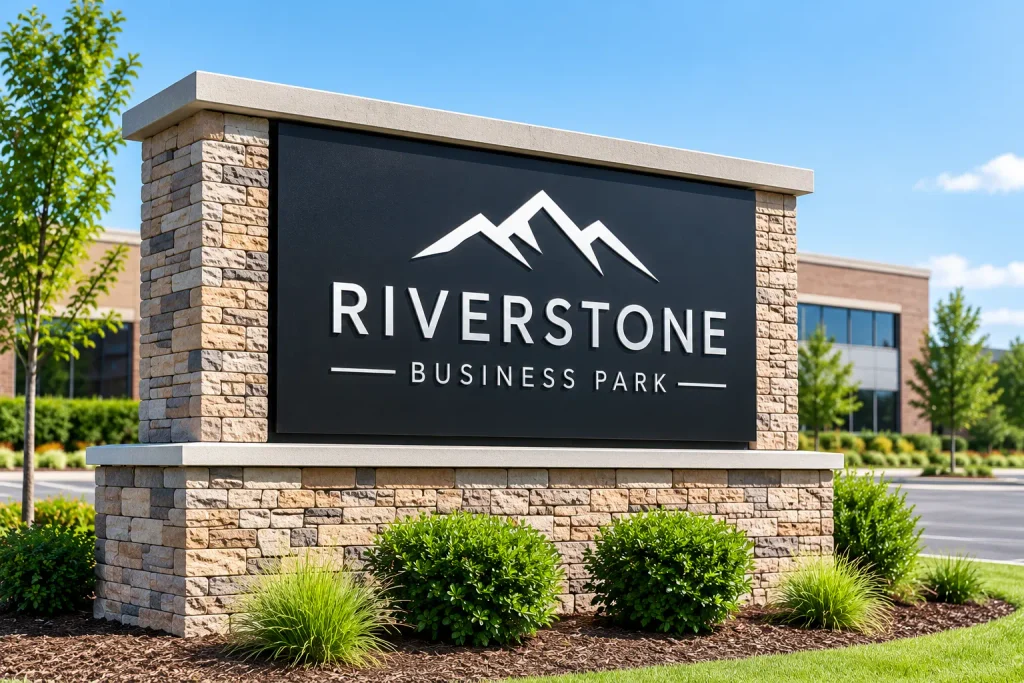
A monument sign is a freestanding, ground-mounted sign built with a solid base that sits close to the earth rather than being elevated on a pole. Unlike pylon signs that tower above a property, a monument sign is designed to feel like a natural extension of the building and landscape around it.
These structures are typically constructed from durable materials such as brick, natural stone, aluminum, or high-density urethane (HDU) foam shaped to mimic masonry. Many monument signs also include illumination, either internal LED lighting or external spotlights, so the business name remains visible after dark. Because of their solid construction and permanent footing, monument signs convey a sense of stability and professionalism that other sign types can’t match.
Businesses install monument signs primarily to increase visibility at street level, reinforce brand identity, and guide visitors to their location without confusion, especially valuable for properties set back from the road or located in busy commercial corridors with multiple competing businesses.
Monument Sign vs. Pylon Sign vs. Wall Sign
Choosing the right exterior sign starts with understanding how each type functions differently on your property.
| Sign Type | Height | Best For | Visibility Range |
| Monument Sign | Ground-level, typically 3–8 ft | Entrances, driveways, office parks | Close-range, eye-level traffic |
| Pylon Sign | Elevated on a pole, 15–50+ ft | Highways, large commercial corridors | Long-distance, high-speed traffic |
| Wall Sign | Mounted directly to the building | Storefronts, strip malls | Building-front visibility only |
A monument sign works best when your goal is to greet visitors at eye level and create a polished, architectural first impression. A pylon sign, on the other hand, is built for drivers spotting your business from a distance on a highway. Many commercial properties actually use both a pylon sign for long-range visibility and a monument sign for close-range branding at the entrance.
Types of Monument Signs
Not all monument signs look or perform the same way. Here are the most common types businesses choose from:
Brick and Stone Monument Signs offer a timeless, formal look that suits schools, banks, churches, and civic buildings. A stone monument sign is extremely durable thanks to its solid masonry construction, though it comes at a higher price point due to material and labor costs.
HDU Foam Monument Signs use high-density urethane shaped and painted to resemble stone, brick, or stucco. They’re significantly lighter and more budget-friendly than real masonry while still delivering a premium appearance — a popular choice for small to mid-sized businesses.
Aluminum and Metal Monument Signs provide a sleek, modern aesthetic and are often paired with a pole cover finished to match the building’s color scheme. They’re lightweight, low-maintenance, and easy to customize with dimensional lettering.
Illuminated and Digital Monument Signs incorporate internal LED lighting or a digital message center that lets you update promotions, announcements, or hours in real time. These are especially effective for retail centers and businesses that rely on foot traffic day and night.
Multi-Tenant Monument Signs function like a directory, listing several businesses operating within the same building or plaza. These multi-tenant outdoor monument signs are common at office parks, medical campuses, and shopping centers, and typically use individual panels or logos for each tenant.
Benefits of Investing in a Custom Monument Sign
A well-designed monument sign does more than mark your address; it actively works as a branding and marketing asset.
Improved Visibility. Positioned at eye level near entrances, monument signs catch the attention of both pedestrians and drivers, making it easier for new customers to locate your business.
Stronger Brand Identity. Custom colors, logos, fonts, and materials let you create a sign that reflects your brand consistently, reinforcing recognition every time someone drives by.
A Sense of Permanence and Trust. Because monument signs are built with substantial, durable materials, they signal to customers that your business is established and here to stay an important trust factor before someone even walks through your door.
Better Property Value. A tasteful, well-maintained monument sign enhances curb appeal, which can positively impact how tenants, customers, and even appraisers perceive the overall property.
Local Code Compliance. Many municipalities restrict the height of pole and pylon signs but allow more flexibility for ground-level monument signage, making it a practical way to maintain visibility while staying within zoning rules.
How Much Does a Monument Sign Cost?
Monument sign pricing varies widely depending on several factors, so it’s difficult to give a single number without a proper consultation. That said, here’s what typically drives the cost:
- Material choice: brick and natural stone cost more than HDU foam or aluminum
- Size and height: larger signs require more material and structural support
- Illumination: internally lit or digital signs cost more than non-illuminated designs
- Number of tenants: multi-tenant directory signs need additional panels and layout planning
- Site conditions: excavation, electrical work, and foundation requirements can add to installation costs
- Permitting: some municipalities require engineering drawings or permit fees before installation
Because these variables shift the final price significantly, the most reliable way to get an accurate estimate is to request a free consultation with a local sign company that can assess your property and design goals.
Design Tips for an Effective Monument Sign
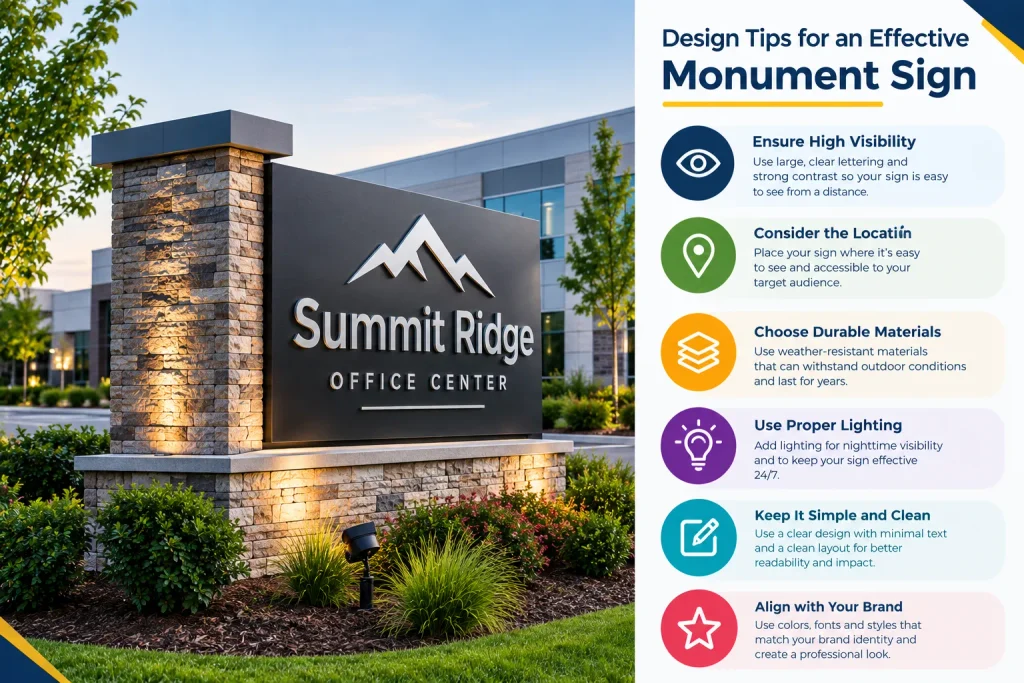
A monument sign should be legible, on-brand, and functional, not just decorative. Keep these principles in mind when planning your design:
- Keep messaging simple. Overcrowded signs are hard to read from a moving vehicle. Stick to your business name, logo, and essential information.
- Use high contrast. Pairing a dark background with light lettering (or vice versa) improves readability at a distance and in different lighting conditions.
- Match your surroundings. A sign that complements your building’s architecture looks more intentional and professional than one that clashes with it.
- Growth plan. If your monument sign will list multiple tenants, design the layout so panels can be added or swapped without a full redesign.
- Add illumination strategically. Lighting extends your sign’s visibility well beyond business hours, which matters if your location gets evening or early-morning traffic.
Permits and Zoning Considerations
Because monument signs are permanent structures installed at street level, most cities require a permit before installation. Local ordinances often regulate sign height, square footage, setback distance from the property line, and illumination levels. Some municipalities in historic districts or planned developments may also have additional design guidelines.
Skipping this step can lead to fines or a forced removal of the sign after installation, so it’s worth working with a sign company experienced in navigating local codes. A knowledgeable provider will typically handle the site survey, permit application, and any required engineering documentation on your behalf.
Choosing the Right Monument Sign Company
Not every sign company offers the same level of service, so it’s worth evaluating a few things before committing to a provider:
- Do they handle design, fabrication, permitting, and installation in-house, or do they outsource parts of the process?
- Can they show a portfolio of monument signs similar in style or industry to what you need?
- Do they offer maintenance or repair services after installation?
- Are they familiar with your local zoning and sign code requirements?
A full-service provider that manages the entire process from initial consultation to final installation typically delivers a smoother experience and a more cohesive final product.
Frequently Asked Questions
How long does a monument sign last?
With proper materials and maintenance, a monument sign can last 15–20 years or more. Brick and stone signs tend to have the longest lifespan, while HDU foam and aluminum signs require less structural upkeep but may need repainting or resurfacing over time.
Do I need a permit to install a monument sign?
In most cities, yes. Local zoning codes typically regulate sign height, size, and placement. A professional sign company can help manage the permit application process for you.
What’s the difference between a monument sign and a pylon sign?
A monument sign is ground-level and designed for close-range visibility, while pylon signs are elevated on poles for long-distance visibility, often along highways or busy roads.
Can a monument sign be illuminated?
Yes. Monument signs can include internal LED lighting, external spotlights, or digital message centers to remain visible after dark.
Is a monument sign a good investment for a small business?
Absolutely. Even smaller, HDU foam or aluminum monument signs can significantly boost visibility and brand recognition at a fraction of the cost of masonry or digital options, making them accessible for businesses of nearly any size.
Conclusion
A monument sign is more than just a way to display your business name; it’s a long-term branding investment that shapes how customers perceive your business before they even step inside. Whether you’re outfitting a single storefront, a multi-tenant office park, or a school campus, choosing the right materials, design, and sign partner makes all the difference in the final result.
If you’re ready to order a custom monument sign for your property, working with an experienced local sign company ensures your design is both visually striking and fully compliant with local codes, giving your business a professional, lasting first impression from the moment someone pulls into the parking lot.
What a monument sign is — and why businesses buy them
A monument sign is a low-profile, ground-mounted freestanding sign, typically 4 to 10 feet tall, positioned near a street entrance or property line. Unlike tall pylon signs built for highway visibility, monuments speak to local traffic: drivers and pedestrians passing your entrance. Churches, schools, medical campuses, office parks, retail plazas, restaurants, and residential developments use them as permanent landmarks. A well-built monument sign identifies your location, signals permanence and credibility, and advertises to everyone who drives by, 24 hours a day.
Types and materials compared
Monument signs come in two broad families. Fabricated monuments — aluminum cabinets, HDU foam with a rock-hard protective coating, or aluminum composite panels — are the cost-effective route ($5,500–$18,000+). They can be shaped, textured, and finished to mimic stone or stucco at a fraction of the weight and cost. Masonry monuments — brick, natural stone, manufactured stone veneer, poured concrete — cost more ($15,000–$45,000+) but deliver an architectural, permanent presence. Many projects split the difference: a masonry base with a fabricated aluminum cabinet on top. For the sign face: dimensional letters, front-lit or halo-lit channel letters, internally illuminated cabinets, or a full LED message center for changeable copy.
What monument signs really cost
A simple single-faced aluminum monument starts around $5,000–$8,000 for the structure; most illuminated custom monuments land between $10,000 and $25,000; stone or brick monuments with premium lighting run $25,000–$45,000+. Beyond fabrication, budget for the “invisible” costs: sign permits ($200–$1,000), structural engineering drawings ($500–$2,000), foundation and site work, electrical runs, and professional installation ($2,000–$8,000+). Because we’re a factory-direct manufacturer, the fabrication portion — usually the largest line item — carries no reseller markup.
Permits, engineering, and foundations: the unglamorous essentials
Start the permit conversation with your city or county before finalizing the design — setback rules, height limits, and illumination restrictions vary wildly. Engineered footing drawings are non-negotiable for permitted structures; we supply shop drawings, and your local engineer stamps them for your jurisdiction’s wind-load requirements. The foundation itself is poured by your local contractor to our dimensions. Add permit review to your schedule on day one.
Single-sided vs. double-sided — and message centers
Single-sided monuments suit properties where traffic approaches from one side; double-sided versions typically add 40–60% to fabrication cost but serve corner lots and two-way streets. An LED electronic message center adds $10,000–$30,000 but turns a static landmark into a daily marketing channel — it earns its keep for multi-tenant properties, churches, schools, and municipalities.
Ordering a custom monument sign
Send your logo, building photos, and site dimensions through our quote form. We’ll return a free mockup showing the monument in proportion to your entrance, material and lighting recommendations, and a firm itemized quote. Once you approve, fabrication takes several weeks while your installer handles permits and the foundation in parallel. Ready to anchor your entrance? Request your free monument sign mockup and quote today — factory-direct pricing, engineered drawings included, shipped anywhere in the US, Canada, Europe, or Australia.
How much does a monument sign cost?
The market range for custom monument signs is roughly $5,000 to $30,000+. Non-illuminated aluminum or foam-core monuments typically run $5,500–$18,000; adding LED illumination or an electronic message center pushes most projects into the $10,000–$25,000 range. Request a free mockup and we’ll give you a firm, itemized quote.
What materials are monument signs made from?
Common options include fabricated aluminum, high-density urethane (HDU) or EPS foam with a protective hard-coat finish, brick, natural or manufactured stone, poured concrete, and stucco. Aluminum and coated foam are the most cost-effective; masonry options cost more but deliver a permanent, architectural look.
Do monument signs need a permit?
Almost always, yes. Municipalities typically require a sign permit and sometimes a building permit, plus engineered drawings showing footings rated for local wind loads. We provide specification and shop drawings to support your permit application — plan for 2–6 weeks of municipal review.
How long does it take to build a monument sign?
Monument signs take longer than most other sign types because of their size and structural complexity. Expect several weeks from approved design to shipment, plus permit review time and site preparation on your end. If you have a grand opening date, tell us upfront.
What lighting options are available for monument signs?
Halo-lit or front-lit channel letters mounted on the monument face, internally illuminated sign cabinets, spotlights or ground floodlights, full-color LED electronic message centers, and dimensional letters for a classic non-illuminated look. Our LED modules are rated for 50,000+ hours.
Who installs a monument sign?
Installation is handled by your local licensed sign installer or general contractor — concrete footings, crane placement, and electrical hookup. We manufacture the complete sign structure and supply engineered drawings, mounting details, and wiring diagrams.
How do monument signs hold up in harsh weather?
Very well when built correctly. Aluminum structures with powder-coat finishes, sealed LED systems, and properly engineered footings are designed for decades of outdoor exposure.