
Blade signs are among the most compact — and therefore most affordable — commercial sign types you’ll encounter. Because they’re small relative to channel letters or monuments, they’re also the sign category where factory-direct pricing makes the most visible difference: you’re paying for a cabinet, faces, and a bracket, not a project-sized markup.
The honest answer as of October 2026: a blade sign’s final cost is set by cabinet size, whether it’s single- or double-sided, illumination, and the mounting bracket. A small non-illuminated single-sided blade is the least expensive configuration; a large double-sided illuminated blade with a custom decorative bracket costs several times more. Exact pricing depends on your configuration, so request a quote for exact pricing once you’ve narrowed your choices using this guide.
Blade signs (also called projecting signs) mount perpendicular to the building facade, jutting out over the sidewalk so pedestrians see them head-on. They’re the classic choice for downtown retail streets, cafes, boutiques, barbershops, and historic districts — anywhere foot traffic, not highway traffic, is your audience.
1. Cabinet Size
Common blade sign sizes run from about 2×3 feet up to 4×8 feet. Cost scales directly with face area: a 3×5-foot cabinet uses more than twice the aluminum and acrylic of a 2×3-foot one, plus more LEDs if illuminated and a sturdier bracket to carry the extra weight and wind load.
Bigger isn’t automatically better for a blade sign. Because these signs are read by pedestrians at close range, a 2×3 or 3×4 cabinet is often perfectly legible — and keeps both fabrication and bracket costs down. Check your local sign code before sizing up: many downtown districts cap projecting sign dimensions, and designing to the code maximum when you don’t need it just spends money.
2. Single-Sided vs. Double-Sided
| Configuration | What’s included | Relative cost |
|---|---|---|
| Single-sided | One finished face, one graphics set, lighter bracket | Lowest — least material and graphics |
| Double-sided | Two finished faces, two graphics sets, often more LEDs | Noticeably more — but well under double |
Single-sided means one finished face — cheaper, with less face material, no second set of graphics, and a lighter bracket. It makes sense when foot traffic flows one way (for example, a shop at the end of a block).
Double-sided puts finished faces on both sides, readable from both directions of foot traffic. It adds a second face, a second graphics set, and often more LED components for illumination. It is not twice the price — the cabinet structure and bracket stay largely the same, so the uplift is well under double. For a mid-block sidewalk location with two-way foot traffic, double-sided is usually worth it: it effectively doubles your impressions for a fraction more cost.
3. Illumination
- Non-illuminated: The most affordable option. A painted aluminum cabinet with applied vinyl graphics — effective on well-lit streets and in districts where illumination is restricted. No electrical work, no power supplies, nothing to maintain electrically.
- Internally illuminated: LED modules inside the cabinet shine through acrylic faces — essentially a small lightbox turned sideways. A moderate cost step up that buys genuine nighttime visibility. LED modules rated for 50,000+ hours keep running costs minimal.
- Externally lit: A non-illuminated blade paired with a gooseneck or spot fixture mounted above it. You buy the fixture separately, and it needs its own electrical connection. A good middle path when you want nighttime presence without an internally lit cabinet.
If your street has good ambient lighting and your hours end at dusk, non-illuminated saves real money. If you’re a restaurant, bar, or evening retail, illumination pays for itself in after-dark visibility.
4. Mounting Bracket and Hardware
The bracket is easy to overlook in budgeting, but it’s structural — it holds your sign over a public sidewalk:
- Standard projecting bracket: A straightforward steel arm, typically included or modestly priced with most orders. Sized to the cabinet’s weight and wind load.
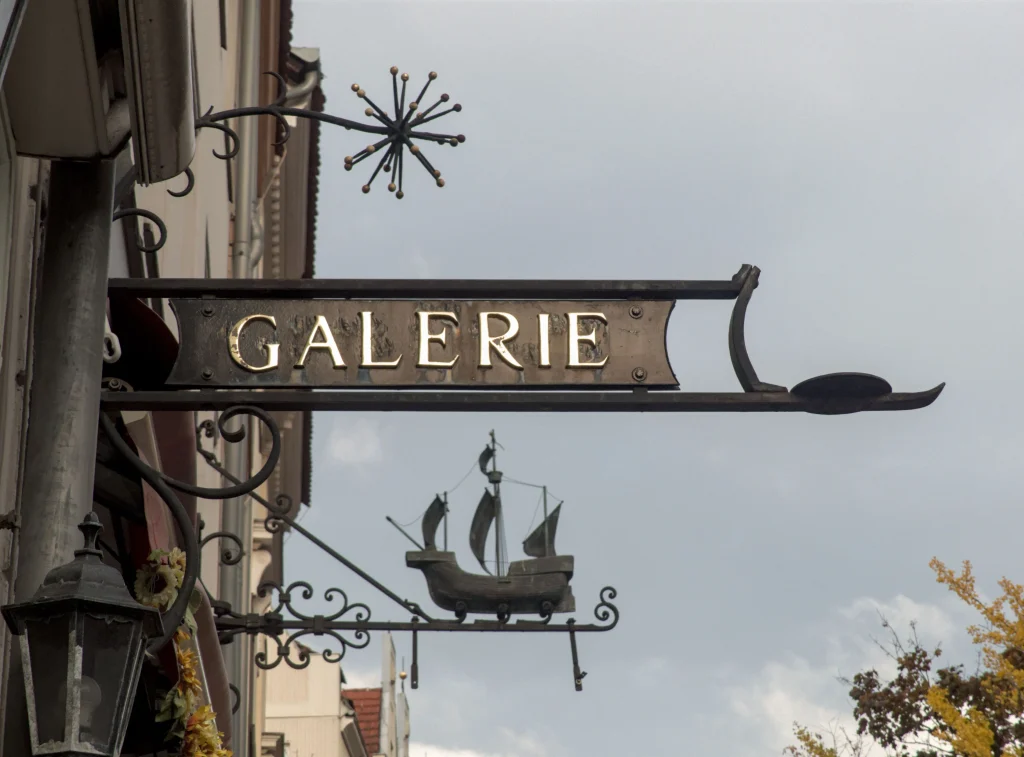
- Decorative or custom brackets: Scrollwork or period-style designs for historic districts — these are fabricated metalwork in their own right and add meaningful cost. In designated historic areas, though, they’re often required by the design review board, so budget for them from the start.
- Wall conditions: Mounting to EIFS, stucco over foam, or fragile historic masonry may require special anchors, quoted by your installer.
One rule that never bends: never undersize the bracket to save money. A failed mount over a sidewalk is a liability event, not a savings. The bracket must be engineered for the cabinet’s weight plus wind load, full stop.
5. Graphics and Lettering
Flat vinyl graphics applied to the faces are the economical standard — crisp, durable, and easy to update later. Dimensional letters or a routed logo mounted to the faces cost more but give the sign depth and a crafted, upscale feel. For double-sided blades, you’re paying for graphics on both faces, so keep both sides’ designs consistent to control art costs.
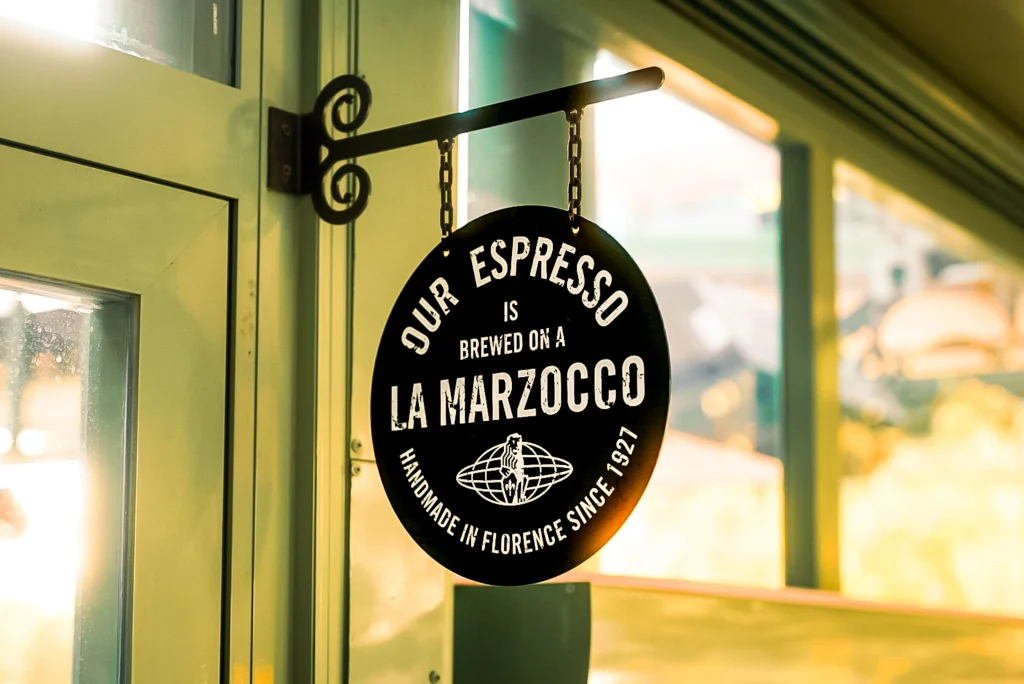
Custom shapes also live in this budget line: rectangular cabinets are the baseline. Circles, shields, ovals, and other custom shapes require custom-cut faces and more complex cabinet work, adding cost. They also stand out dramatically on a street of rectangles — for a boutique or café, that differentiation is often worth the premium.
6. Permits and Historic-District Review
Most cities require a sign permit for a projecting sign, and municipalities regulate size, height above the walkway, and mounting method — a blade sign hangs over public right-of-way, so clearance rules are strict and non-negotiable. Historic districts frequently add a design review layer that governs materials, colors, bracket style, and illumination.
Factor permit fees and review timelines into your project plan early. A good manufacturer supplies specification drawings that make the permit process smoother, but fees and approvals are between you and your municipality.
What Affects the Quote: Cost-Factor Comparison
| Factor | Low-cost choice | Higher-cost choice | Price impact |
|---|---|---|---|
| Cabinet size | 2×3 ft | 4×8 ft | High — material scales with area |
| Faces | Single-sided | Double-sided | Medium — well under double |
| Illumination | Non-illuminated | Internally illuminated LED | Medium |
| Bracket | Standard steel arm | Decorative/custom scrollwork | Medium |
| Graphics | Flat vinyl | Dimensional letters, custom shapes | Medium |
| Wall conditions | Standard masonry | EIFS, historic masonry | Low-medium (installer quote) |
The Factory-Direct Advantage on Small Signs
Blade signs are a category where local pricing can be surprisingly inflated. Local shops apply similar project minimums and margins to a blade sign as they do to much larger signs — the overhead of taking your order, forwarding it to a wholesale fabricator, and managing the job doesn’t shrink just because the sign is small.
Buying factory-direct keeps the economics honest: you pay for the actual cabinet, faces, LEDs, and bracket without a retail layer priced for a bigger-ticket project. For a sign type that’s already compact and affordable, removing the middleman’s margin is often the difference between a good price and a great one.
How to Save Money on a Blade Sign
- Size to your audience. Pedestrian-scale signage doesn’t need highway-scale dimensions — a 2×3 or 3×4 cabinet is plenty for most storefronts.
- Go single-sided where foot traffic flows one direction.
- Choose non-illuminated if your street is well lit and your hours are daytime.
- Use the standard bracket unless historic-district rules require decorative ironwork.
- Keep graphics flat vinyl for the first version — dimensional letters can always be added later.
- Bundle with your main sign. If you’re also ordering channel letters or a storefront sign, ordering the blade at the same time shares crating and freight costs.
How to Get an Exact Quote for Your Blade Sign
- Describe the location. A photo of your facade helps enormously — the mounting surface and sidewalk clearance shape the bracket design.
- Choose your configuration. Size, single- or double-sided, illuminated or not, bracket style.
- Get a free mockup. See the blade sign rendered on your building — both faces if double-sided — before spending anything.
- Receive an itemized quote. Cabinet, faces, graphics, illumination, bracket, hardware, crating, and shipping listed separately.
Blade signs are among the quicker custom signs to fabricate — typically faster than channel letters — so add freight transit time and your installer’s schedule on top of a relatively short production window.
Frequently Asked Questions
How much does a blade sign cost?
Blade signs are among the most affordable commercial sign types. Final cost is set by cabinet size, single- vs. double-sided faces, illumination, and bracket style — a small non-illuminated single-sided blade is the least expensive configuration, while a large double-sided illuminated blade with a custom decorative bracket costs several times more. Request a quote for exact pricing based on your configuration.
Do blade signs come with the mounting bracket?
Standard projecting brackets are typically included or quoted with the sign. Decorative or custom-fabricated brackets cost more and are quoted separately.
Is a double-sided blade sign twice the price of single-sided?
No — not twice, but noticeably more. The cabinet structure and bracket stay largely the same, so the uplift is well under double. For two-way foot traffic, the extra impressions usually justify it.
Can blade signs be illuminated?
Yes. Internally illuminated blade signs use LED modules behind acrylic faces, just like a small lightbox. Non-illuminated versions can also be paired with an external gooseneck fixture.
What is a typical blade sign size?
Common sizes range from about 2×3 feet for small boutiques to 4×8 feet for high-traffic retail streets. Your local sign code often sets maximums — check it before finalizing dimensions.
Do I need a permit for a blade sign?
Most cities require one, and historic districts often add design review. Municipalities regulate size, height above the walkway, and mounting method.
How long does a blade sign take to make?
Blade signs are among the quicker custom signs to fabricate — typically faster than channel letters. Add freight transit time and your installer’s schedule on top.
Blade sign vs. hanging sign — what’s the difference?
The terms overlap. “Blade sign” usually means a rigid projecting cabinet, while hanging signs can include suspended panels and brackets of various styles. If you’re unsure which fits your facade, send a photo and we’ll advise.
Get Your Exact Blade Sign Price
Blade sign pricing is genuinely configuration-driven — two signs that look similar in photos can differ significantly once size, faces, illumination, and bracket are specified. The fastest way to a firm number is a free mockup on your actual building.
Get a free 3D mockup and exact quote — or contact us to talk through bracket and mounting options with a signage specialist.