
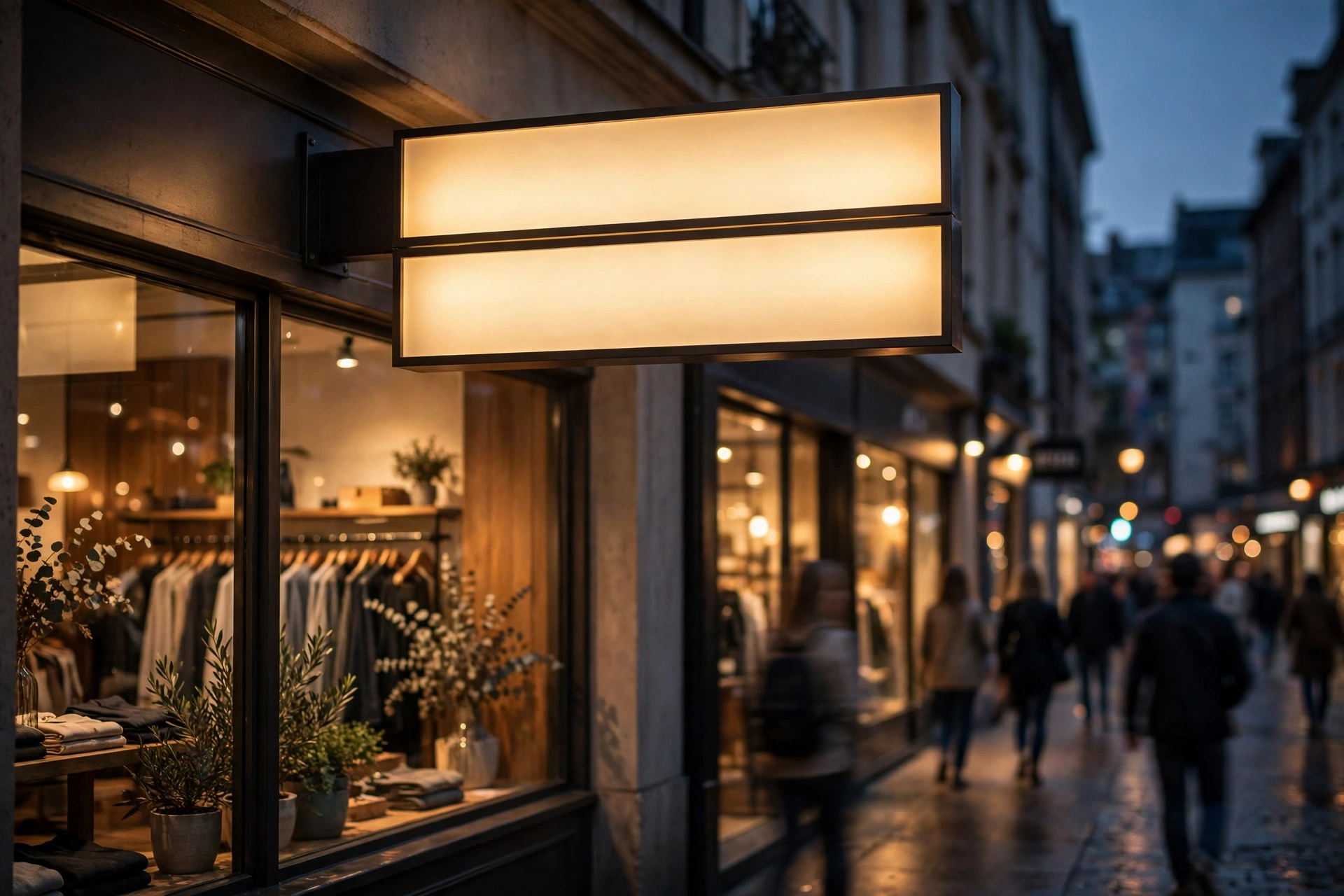
The $590 sign with the $2,400 project
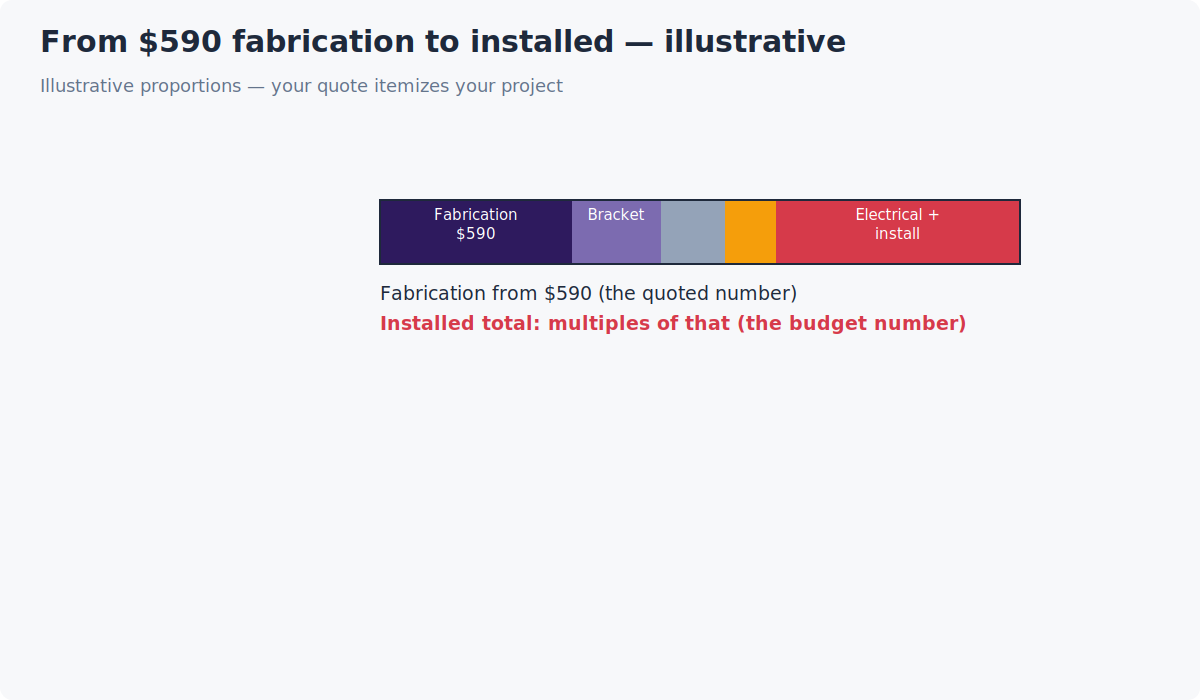
Consider this illustrative example (not a real project): a boutique owner sees a factory price of $590 for a blade sign and budgets $600. Then come the bracket upgrade for a 3×4-foot cabinet, the city sign permit, the electrician’s hookup for the illuminated version, and the installer’s half-day on a ladder over a public sidewalk. The sign was $590. The project was $2,400. Nothing was misrepresented — the fabrication quote was exactly what it claimed to be. The buyer simply budgeted the part instead of the whole.
That is the entire discipline of blade-sign pricing in one story: the fabrication number is the starting line, not the finish. Blade signs are among the most affordable commercial sign types precisely because they are compact — a cabinet, two faces, and a bracket, not a construction project. But “affordable” only stays true if you budget all five cost buckets. This guide gives you the factory-direct numbers, the math that connects them to installed totals, and the checklist that keeps the project honest.
Quick answer: how much does a blade sign cost?
A blade sign’s fabrication starts at $590 per sign from UrbanSign Works — fabrication to your approved design. The final installed project typically runs several times that, because the finished cost is set by five factors: cabinet size, single- vs. double-sided faces, illumination, the mounting bracket, and graphics — plus the local costs (permits, electrical, installation) that every projecting sign carries.
The honest formula: fabrication ($590+) + bracket + freight + permit + electrical + installation = project total. Compare fabrication quotes to fabrication quotes, and budget the local buckets separately. Anyone who gives you a single installed number without itemizing is asking you to trust their math instead of showing it.
Our starting price, stated plainly
Because we manufacture the cabinets ourselves, we publish the number instead of hiding behind “request a quote”:
| Product | Starting at (fabrication, per sign) |
|---|---|
| Blade sign | $590 |
Starting prices cover fabrication to your approved design. Insured freight delivery to the United States, Europe and Australia, local permits, electrical work, and installation are quoted separately — installation is handled by your local licensed contractor.
That separation is not fine print; it is the point. A blade sign hangs over a public sidewalk, which means the bracket is structural engineering, the permit is a municipal process, and the installation is licensed work. No factory can responsibly bundle those into one number. What we can do is make the fabrication number exact and the rest itemized — so you see where every dollar goes.
What actually sets the price: the five cost factors
1. Cabinet size
Common blade cabinets run from about 2×3 feet up to 4×8 feet, and cost scales directly with face area — a 3×5-foot cabinet uses more than twice the aluminum and acrylic of a 2×3, plus more LEDs if illuminated and a sturdier bracket for the extra weight and wind load.
But bigger is not automatically better. Blade signs are read by pedestrians at close range, not drivers at highway speed — a 2×3 or 3×4 cabinet is perfectly legible for most storefronts, and keeps fabrication and bracket costs down. (Research on on-premise sign legibility, such as the Sign Research Foundation’s work on sign visibility, consistently shows viewing distance — not size alone — decides readability.) Check your local sign code before sizing up: many downtown districts cap projecting-sign dimensions, and designing to the code maximum when you do not need it just spends money.
2. Single-sided vs. double-sided
| Single-sided | Double-sided | |
|---|---|---|
| What’s included | One finished face, one graphics set, lighter bracket | Two finished faces, two graphics sets, often more LEDs |
| Relative cost | Lowest | Noticeably more — but well under double |
| Best when | Foot traffic flows one direction (end of block) | Two-way sidewalk traffic (mid-block) |
Double-sided is not twice the price — the cabinet structure and bracket stay largely the same, so the uplift is well under double. For a mid-block location, it effectively doubles impressions for a fraction more cost, which is usually worth it.
3. Illumination
Three honest options, three honest prices:
- Non-illuminated. Painted aluminum cabinet with applied vinyl graphics. Cheapest; effective on well-lit streets and in districts that restrict illumination. No electrical work, no power supplies, nothing to maintain electrically.
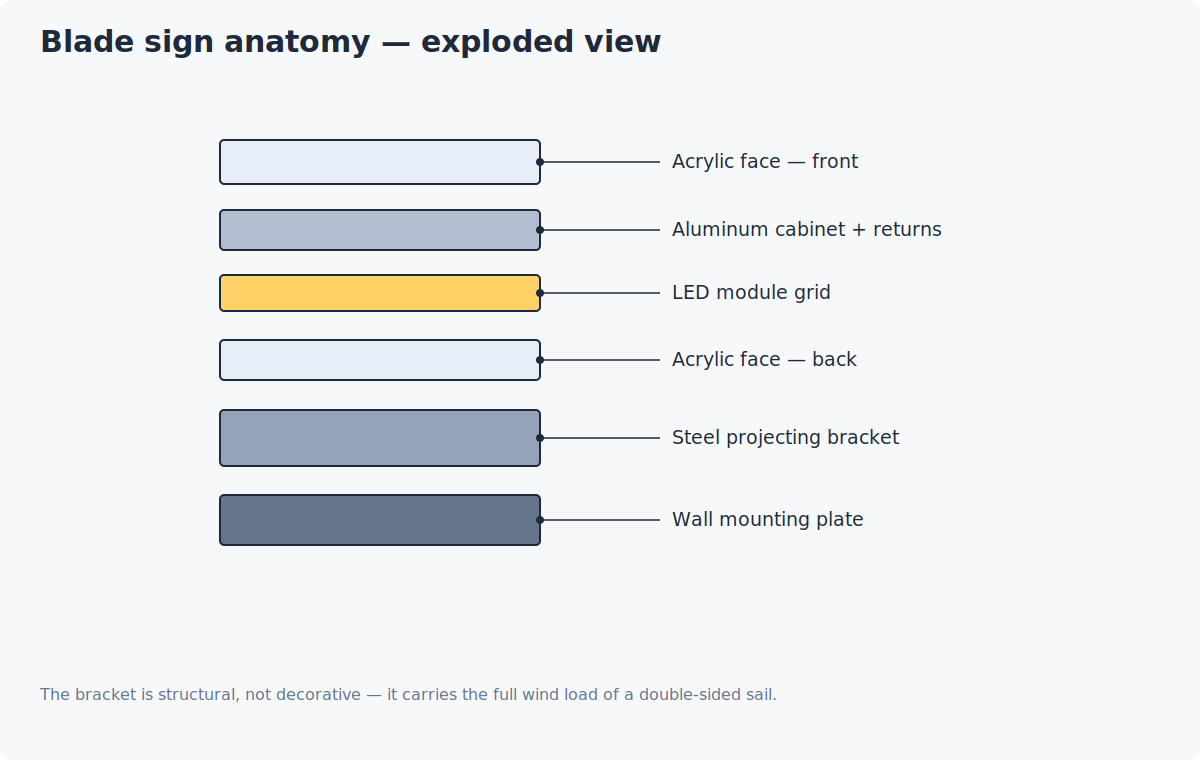
- Internally illuminated. LED modules inside the cabinet shine through acrylic faces — a small lightbox turned sideways. A moderate step up that buys genuine nighttime visibility; LED modules rated for 50,000+ hours keep running costs minimal.
- Externally lit. A non-illuminated blade paired with a gooseneck or spot fixture above it. The fixture is bought separately with its own electrical connection — a good middle path for nighttime presence without an internally lit cabinet.
If your street is well lit and your hours end at dusk, non-illuminated saves real money. If you are a restaurant, bar, or evening retail, illumination pays for itself in after-dark visibility.
4. Mounting bracket and hardware
The bracket is the most underestimated line item — and the one you must never cheap out on. It holds your sign over a public sidewalk:
- Standard projecting bracket. A straightforward steel arm, sized to the cabinet’s weight and wind load. Typically included or modestly priced.
- Decorative/custom brackets. Scrollwork or period-style ironwork for historic districts — genuine fabricated metalwork, genuinely more expensive. In designated historic areas they are often required by the design review board, so budget them from the start.
- Wall conditions. Mounting to EIFS, stucco-over-foam, or fragile historic masonry may need special anchors — quoted by your installer, not the factory.
The rule that never bends: never undersize the bracket to save money. A failed mount over a sidewalk is a liability event, not a savings. The bracket must be engineered for the cabinet’s weight plus wind load, full stop.
5. Graphics and lettering
Flat vinyl graphics on the faces are the economical standard — crisp, durable, easy to update later. Dimensional letters or a routed logo mounted to the faces cost more but add depth and a crafted feel. Custom cabinet shapes (circles, shields, ovals) need custom-cut faces and more complex cabinet work — a real premium, but on a street of rectangles, the differentiation is often worth it for a boutique or café. For double-sided blades, keep both faces’ designs consistent to control art costs.
The factory-direct advantage on small signs
Blade signs are the category where local pricing is most visibly inflated. A local shop applies similar project minimums and margins to a blade sign as to a monument — the overhead of taking your order, forwarding it to a wholesale fabricator, and managing the job does not shrink because the sign is small. Buying factory-direct keeps the economics honest: you pay for the actual cabinet, faces, LEDs, and bracket, without a retail layer priced for a bigger-ticket project. On a sign type that starts at $590, removing the middleman’s margin is often the difference between a good price and a great one.
Worked example: from $590 to installed
Illustrative example: a 3×4-foot double-sided illuminated blade:
| Line item | Typical range | Provided by |
|---|---|---|
| Cabinet fabrication | from $590 | manufacturer |
| Bracket (standard steel) | included–modest | manufacturer |
| Insured freight | quoted per location | carrier |
| Sign permit | $50–$400+ | municipality |
| Electrical hookup | $200–$600+ | local electrician |
| Installation | $300–$800+ | local licensed contractor |
The fabrication is the fixed, knowable number. The local buckets vary by city, wall, and sidewalk — which is exactly why itemized quotes beat single numbers. (The International Sign Association tracks sign-code developments and is a solid reference when you research your municipality’s requirements.) For the full budgeting method across sign types, see how much a business sign costs.
How to save money without cutting corners
- Size to your audience. Pedestrian scale, not highway scale — 2×3 or 3×4 covers most storefronts.
- Go single-sided where foot traffic flows one way.
- Choose non-illuminated if your street is well lit and your hours are daytime.
- Use the standard bracket unless historic-district rules require decorative ironwork.
- Start with flat vinyl graphics — dimensional letters can be added later.
- Bundle with your main sign. Ordering alongside channel letters or a storefront sign shares crating and freight.
Ordering checklist
- Photograph your facade — the mounting surface and sidewalk clearance shape the bracket design.
- Confirm your sign code: max projection, clearance height, illumination rules.
- Choose configuration: size, single/double-sided, illumination, bracket style.
- Get a free 3D mockup — targeted within two business days of a complete brief — and see both faces on your building before spending anything.
- Demand an itemized quote: cabinet, faces, graphics, illumination, bracket, hardware, crating, freight — separately.
- Budget permits, electrical, and installation as their own lines.
- Schedule the installer after fabrication completes — blade signs fabricate faster than channel letters, so add freight transit plus your installer’s lead time. Standard fabrication is targeted within 15 business days after final design approval.
FAQs
How much does a blade sign cost?
Fabrication starts at $590 per sign (factory-direct, to your approved design). Installed project totals run higher depending on bracket, permits, electrical, and installation — budget all five buckets, not just the cabinet.
Is a double-sided blade sign twice the price of single-sided?
No — noticeably more, but well under double. The cabinet structure and bracket stay largely the same; you are adding a second face, graphics set, and often more LEDs.
Do blade signs come with the mounting bracket?
Standard projecting brackets are typically included or quoted with the sign. Decorative or custom-fabricated brackets cost more and are quoted separately.
Can blade signs be illuminated?
Yes — internally illuminated (LED modules behind acrylic faces, like a small lightbox) or externally lit with a gooseneck fixture. Non-illuminated suits well-lit streets and daytime hours.
What is a typical blade sign size?
Common sizes run 2×3 feet for small boutiques up to 4×8 feet for larger facades. For pedestrian-scale reading, 2×3 or 3×4 is plenty for most storefronts — check your local sign code caps first.
How long does a blade sign take?
Blade signs are among the quicker custom signs to fabricate — typically faster than channel letters. Add insured freight transit time and your installer’s schedule on top of production. For configuration detail, see our blade sign guide; for common questions, the FAQ.