
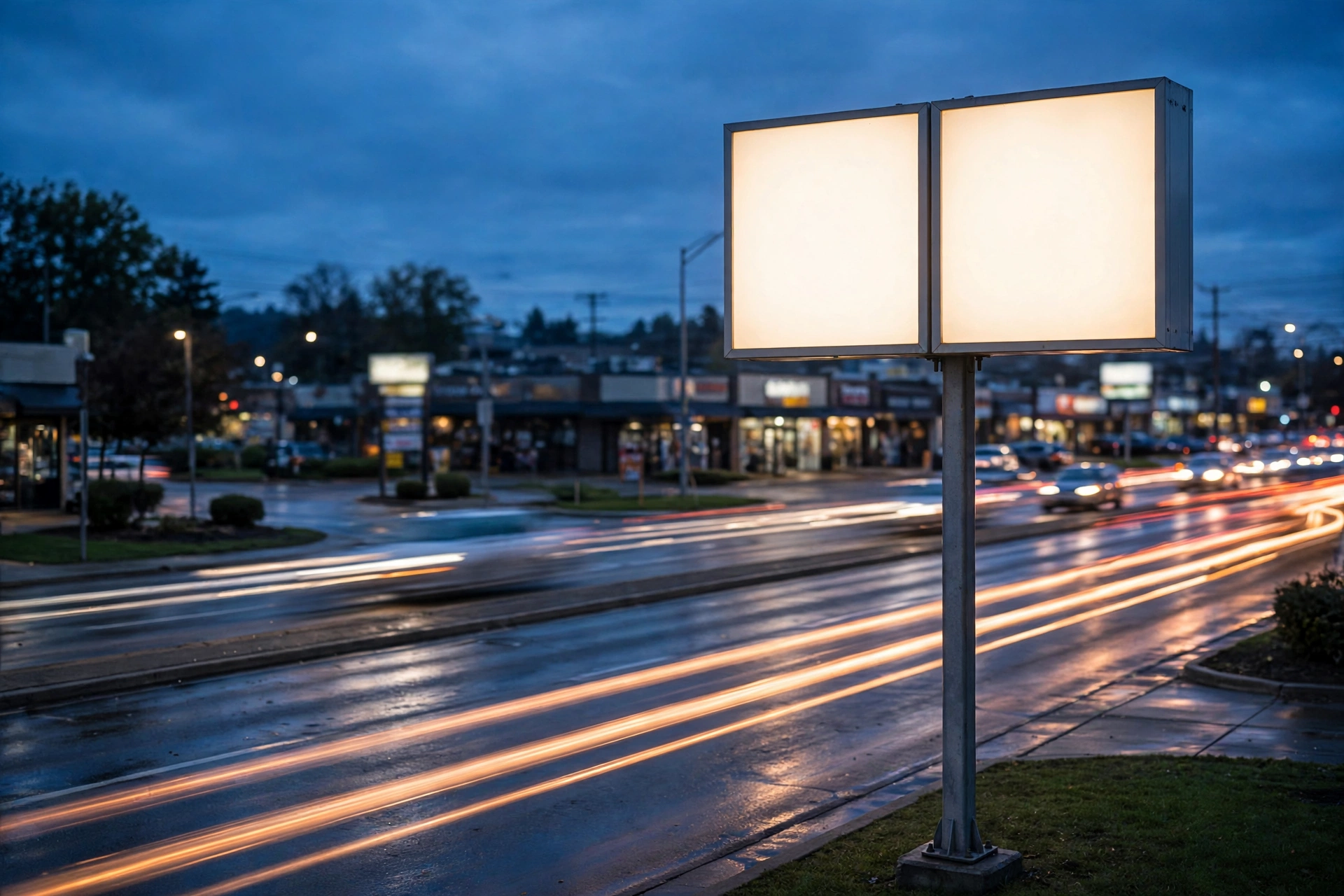
The $4,000 box that glowed wrong
Consider this illustrative example (not a real project): a franchise group orders twelve cabinet signs for new locations. The spec sheet says “LED illuminated, white face.” The first sign goes up and the face glows a sickly yellow — the LED color temperature clashes with the face material. The other eleven are already in fabrication. Re-specifying the LEDs, reprinting the faces, and delaying six store openings costs the group over $4,000 per location in rework and lost time. The sign was built exactly to the brief. The brief was the problem.
That story is why this guide exists. A cabinet sign — a lightbox, box sign, enclosed illuminated panel — looks like the simplest sign you can buy. It is also the sign where small specification mistakes cost the most, because every error gets multiplied across faces, locations, and years of nightly operation. This guide covers how cabinet signs are actually built, which types fit which job, how LED lighting really works inside the box, what drives cost, and how to write a brief a manufacturer can build from without surprises.
Quick answer: what is a cabinet sign?
A cabinet sign is an enclosed, box-shaped sign — an aluminum frame with translucent or routed faces, lit from inside by LEDs — that mounts on a wall, pole, or freestanding base. The face carries your name, logo, or message. You may also hear them called lightboxes or box signs.
They are the workhorse of commercial signage: gas stations, pharmacies, restaurants, dental offices, and strip-mall tenants rely on them because a lit face keeps working long after the shop closes. For a sense of the broader landscape, see our business sign cost guide.
Anatomy of the box: what you’re actually buying
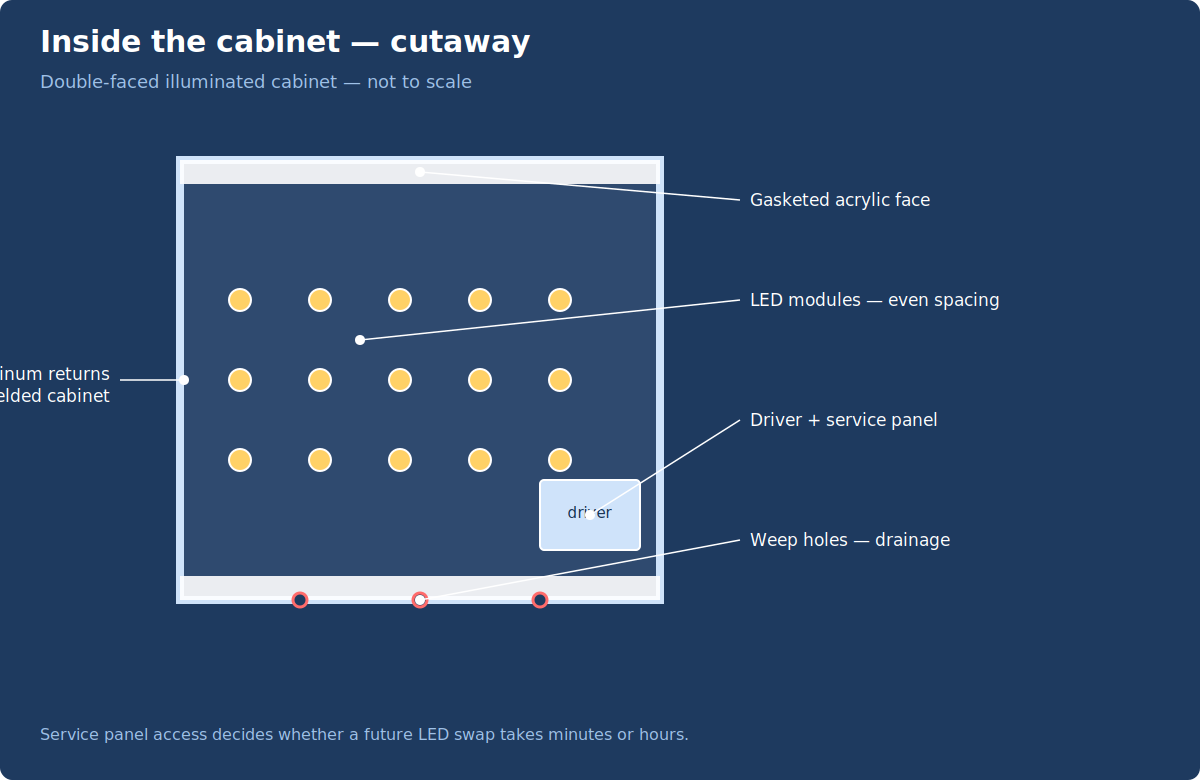
Ask better questions by knowing the three working parts:
The shell. The skeleton is aluminum extrusion or welded square-tube; the returns are the box sides enclosing the interior. Aluminum dominates because it resists rust, stays light enough to mount safely, and takes powder coating well. On larger signs, gauge thickness and internal bracing stop being details and become the engineering — wind load on a 4×8-foot face is a real force, and a quote that doesn’t mention bracing hasn’t thought about it.
The face. What the public sees. Flat acrylic or polycarbonate faces carry printed or vinyl graphics and pass light evenly. Routed aluminum faces have letters cut out and backed with acrylic — the push-through look, dimensional by day and glowing lettering by night. Pan-formed faces are vacuum-shaped for embossed depth. Polycarbonate wins where impact resistance matters (hail, vandalism); acrylic wins on clarity and color range.
The lighting. LED modules mounted on the back or sides, wired to a driver (power supply). Good designs space modules so the face glows evenly — no hot spots, no dark bands. Access matters more than buyers expect: removable faces or service panels let a technician swap a driver without taking the whole sign down. A sealed box with no service access is a future removal job wearing a sign costume.
The main types, and which job each does
Illuminated vs. non-illuminated. Internally lit is the default for any business open after dark. Non-illuminated skips the electrical system — simpler, cheaper, fine for daytime-only businesses or sites with good external lighting. Decide early: adding lighting after fabrication can affect the sign’s electrical certification, and retrofitting a box that wasn’t designed for it is rarely clean.
Single-face vs. double-face. A single-face cabinet mounts flat to a wall. A double-face has two faces back to back — the standard answer for pole signs and roadside placements, where traffic approaches from both directions.
Push-through. Letters or logos routed from the aluminum face, backed with acrylic sitting slightly proud of the surface. By day: crisp, dimensional, premium. By night: glowing lettering against a dark field with excellent contrast. It costs more fabrication effort than a flat printed face, and it shows.
Cabinet-letter (raceway) hybrids. Letters mounted on a slim cabinet backing — the brand reads as distinct characters while one mounted unit handles wiring and structure. The compromise between channel letters and a full box: cleaner than a cabinet, simpler to install than individual letters.
Mounting follows the building and the bylaws: wall-mounted, bracket-hung, pole-mounted, or freestanding. Your sightlines and local sign code usually make this decision for you — check both before falling in love with a mounting style.
How LED lighting actually works inside the box
Each LED module is a small strip or cluster of diodes with a built-in lens, running on a low-voltage driver. LEDs generate little heat and draw modest power, which is kinder to the face material and the electric bill than the fluorescent tubes they replaced.
Quality shows up in four details a spec sheet should name:
- Color temperature matched to the face. A 6500K module behind a warm-white face reads yellow. The module and the face are a system — specify them together.
- Even brightness, edge to edge. Module spacing is engineering, not decoration. Too sparse and you get dark bands; the fix is more modules, not brighter ones.
- Outdoor-rated modules and reachable drivers. Moisture-rated diodes, and drivers mounted where a technician can reach them through the service panel.
- Cold-weather reliability. LEDs start reliably in freezing temperatures — one genuine advantage over old tube systems — but drivers and connections still need proper sealing against condensation and freeze-thaw cycles.
Cabinet signs vs. channel letters vs. monument signs
No honest manufacturer tells you one type wins everywhere. The decision is about the job:
| Cabinet sign | Channel letters | Monument sign | |
|---|---|---|---|
| Best for | Large readable face, multi-location consistency, changeable panels | Upscale architectural look, brand prestige | Property entrance, driver visibility |
| Night presence | Full-face glow | Letter-by-letter glow | Depends on design |
| Fabrication from | $49/sq ft | $129/letter (front-lit) | $2,900/sign |
| Message changes | Easy (swap face/panel) | Hard (new letters) | Moderate |
| Weakness | Can look generic at small sizes | Higher cost per project | Foundation + permits add cost |
Many sites combine types: channel letters on the building with a double-face cabinet at the road, or a monument sign at the entrance with a wall cabinet for the tenant panel. The International Sign Association publishes industry research on sign visibility and conspicuity that backs up these placement choices. For the full cost picture across types, see how much a business sign costs.
What drives the cost
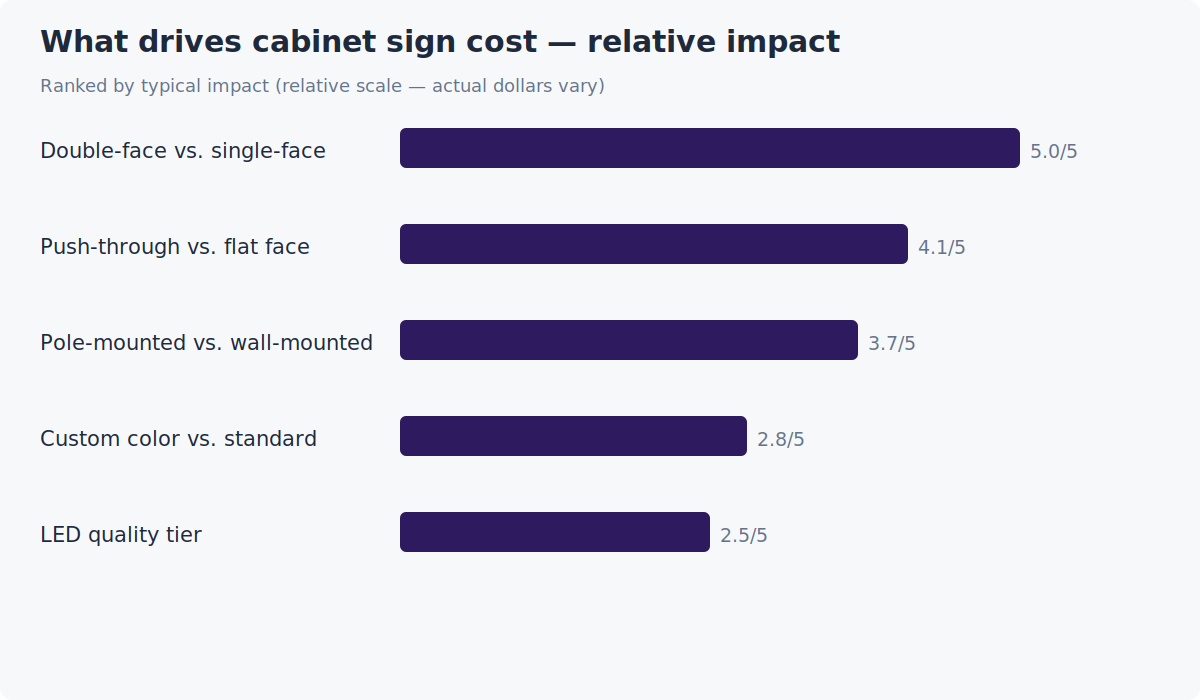
Anyone who quotes a single number without asking questions is guessing. The real cost drivers:
- Size and depth. Larger faces and deeper cabinets need more material and stronger structure.
- Face type. Flat printed < routed push-through < pan-formed, in fabrication effort.
- Illumination. LED module count, driver size, one face or two lit.
- Single vs. double face. Two faces means roughly twice the face fabrication plus more lighting.
- Mounting and structure. Pole mounting, foundations, and tall installations add engineering and steel.
- Finish. Custom color matching and specialty finishes take extra steps.
- Freight and installation. Quoted separately — a cabinet is bulky, and freight is real money.
Our fabrication pricing for cabinet/lightbox signs starts at $49 per square foot (fabrication to your approved design; insured freight and installation quoted separately). Because we manufacture in-house, you pay fabrication cost rather than broker rates stacked on a factory price.
Mistakes that get expensive
Specifying LEDs and face separately. The $4,000 yellow-glow story above. Color temperature, face material, and module spacing are one decision — write them into the same line of the brief.
Ignoring service access. A beautiful sealed box with no removable face or panel means the first driver failure becomes a full removal and shop visit. Ask “how does a technician reach the driver?” before you approve.
Undersizing the structure. A 4×8-foot double-face cabinet on a pole is a sail. If the quote doesn’t mention bracing, gauge, or wind load, the engineering hasn’t been done — and the failure mode is not cosmetic.
Designing for noon, not midnight. Cabinet signs earn their keep after dark. Review the artwork as a backlit face, not a printed sheet: thin strokes disappear, low-contrast color pairs wash out, and busy layouts become unreadable at 40 mph.
Forgetting the second face. Double-face quotes sometimes price one lit face and one “blank” — confirm both faces are lit (or deliberately not) before approval. Changing it later means reopening the box.
Your pre-approval checklist
- [ ] Face type chosen (flat / routed push-through / pan-formed) with the reason written down
- [ ] LED color temperature specified with the face material, not separately
- [ ] Module spacing and driver locations shown on the shop drawing
- [ ] Service access identified (removable face or panel — how does a tech reach the driver?)
- [ ] Structure: gauge, bracing, and mounting method on the drawing
- [ ] Both faces confirmed lit (or deliberately unlit) for double-face units
- [ ] Artwork reviewed as a backlit rendering at viewing distance, not just as print
- [ ] Freight and installation quoted separately and budgeted
- [ ] Local sign code and landlord criteria checked before ordering
- [ ] 3D mockup on your actual building reviewed and approved
FAQs
How long do LED cabinet signs last?
LED modules are commonly rated for tens of thousands of hours — years of nightly use. The face and seals usually need attention before the LEDs do: UV fading, gasket wear, and mounting hardware age faster than the diodes.
Can an old fluorescent cabinet be converted to LED?
Often yes — retrofit LED modules can reuse a sound existing frame. But if the cabinet is corroded, the faces are crazed, or there’s no service access, a fresh cabinet is usually the smarter investment. Have the frame assessed before deciding.
Single-face or double-face — which do I need?
Wall-mounted and read from one direction: single-face. Pole-mounted, roadside, or read from two directions: double-face. When in doubt, stand where your customers will be and count the approaches.
What maintenance does a cabinet sign need?
A seasonal wash of the face, a visual check of seals and fasteners, and a lighting test. Ten minutes, four times a year, prevents most failures.
Do I need a permit for a cabinet sign?
Almost certainly, for exterior installations. Rules cover size, height, setbacks, illumination, and electrical — and they vary by city, county, and landlord. Check with your local planning department and review lease criteria before ordering. Electrical components should carry listings your inspector recognizes, such as UL listings for the North American market.
Why do quotes for the “same” cabinet sign vary so much?
Because “cabinet sign” isn’t a specification. Face type, LED quality, gauge, bracing, finish, and whether freight/installation are included move the number more than the box dimensions do. Compare itemized quotes, not bottom lines.
The factory-direct way to buy one
Here’s how we’d rather you bought a cabinet sign: send us your building photo, logo, and the job the sign has to do. We return a free 3D mockup — targeted within two business days of a complete brief — showing the sign on your actual building, lit, at the right scale. You review materials, LED spec, and structure on the shop drawing with your installer’s eyes on it. We fabricate to the approved design — standard fabrication targeted within 15 business days after final design approval — and ship by insured freight delivery to the United States, Europe and Australia. Your local licensed contractor handles the mounting; every order includes installation guides. Two-year manufacturing warranty on qualifying products, subject to the written warranty terms.
One decision, one manufacturer, no broker margin, no yellow-glow surprises.