
Quick answer
Sign is spelled S-I-G-N. Four letters. The G is silent — the word sounds like “sine.” If that’s all you needed, you’re done. If you’ve ever paused mid-keystroke wondering whether that G really belongs there, keep reading: the reason it’s there is genuinely interesting, and there’s a pattern that makes it unforgettable.
The silent G has a history (and a pattern)
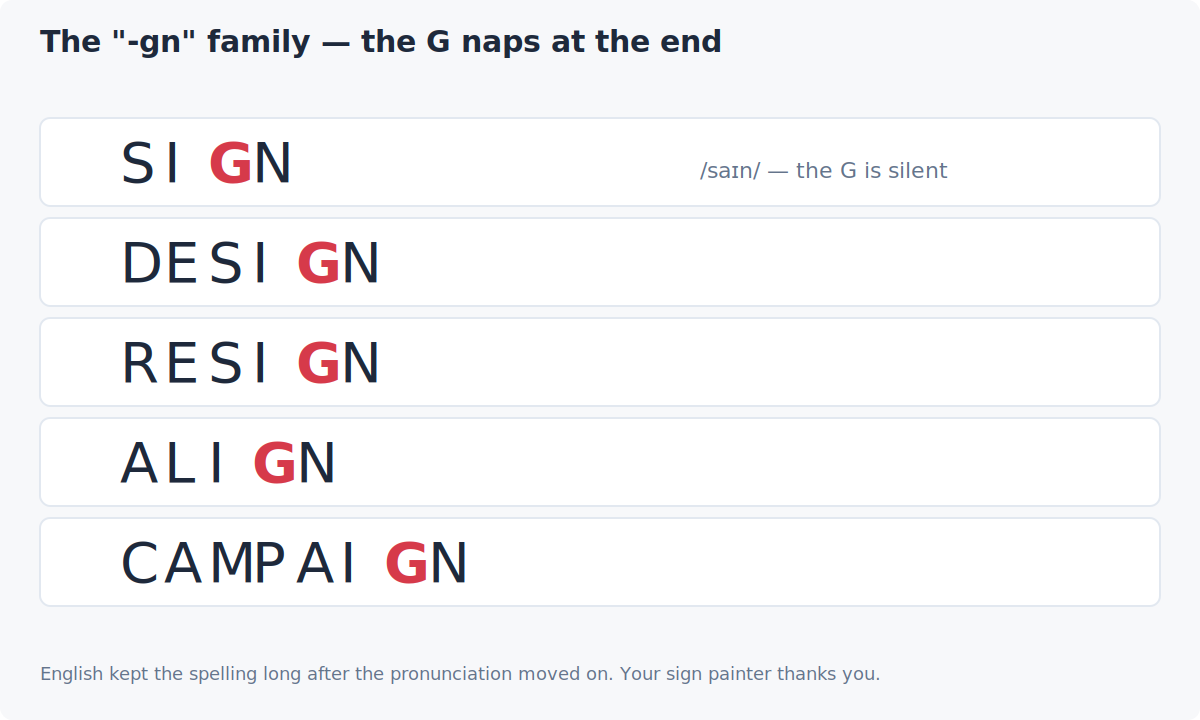
Sign comes from the Latin signum — a mark, a token, a signal (etymology). It traveled through Old French (signe, where the G was pronounced) into English in the early 1200s. Early English speakers said the G too. Over the centuries the sound faded from speech, but the letter stayed in print. English spelling is a museum: it keeps the history long after pronunciation moves out.
Here’s the pattern that makes it stick: when a word ends in -GN, the G is almost always silent. Design. Resign. Align. Campaign. Foreign. Malign. You say the vowel and the N, and you skip the G — every time. Sign isn’t an exception; it’s a card-carrying member of the family. If you can spell design, you can spell sign.
The twist: sometimes the G wakes up
Add certain endings and the silent G suddenly gets pronounced:
- sign → signature (SIG-nuh-chur)
- resign → resignation (rez-ig-NAY-shun)
- design → designation (dez-ig-NAY-shun)
- malign → malignant (muh-LIG-nunt)
Why? Syllable structure. The suffix pulls the G to the end of one syllable and the N starts the next, so your mouth can finally reach it. It’s the same G — it was just napping.
The look-alikes that cause the real trouble
Most “misspellings” of sign aren’t misspellings at all — they’re the wrong word entirely:
- Sign — the everyday word. A board with a message, a gesture, a signal, or writing your name. (Follow the signs to the exit. Please sign here.) Merriam-Webster lists a dozen distinct senses — which is exactly why context matters.
- Sine — a math term. A trigonometric function (opposite over hypotenuse). True homophone: same sound, different spelling, different meaning. Unless you’re doing geometry, you don’t want this one.
- Sigh — the audible breath of the tired or relieved. Ends in a long “eye” sound with no N. Different silent-letter pattern, different word.
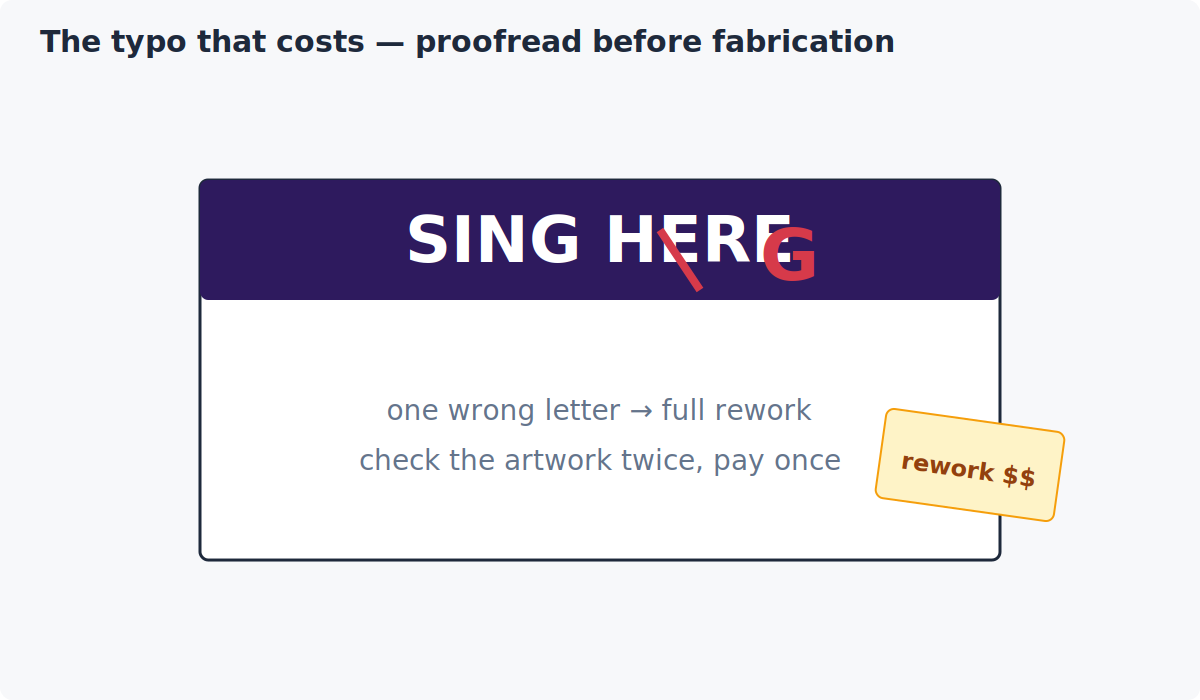
- Sing — the typo. The letters are so close that fast fingers swap the G and N. “Sing here” on a contract is embarrassing. On a storefront, it’s a landmark.
Quick test when you’re unsure: ask what the word is doing. Message on a board? Sign. Triangle math? Sine. Exasperated breath? Sigh. Melody with your voice? Sing.
The whole family, spelled right
- Sign — noun and verb. The sign is above the door. Sign the form.
- Signs — plural, no apostrophe. (The signs are lit at night. Writing “sign’s” for a plural is one of the most common errors on real storefronts.)
- Signed — past tense. The G stays silent.
- Signing — present participle. Also the word for using sign language.
- Signage — the collective noun for signs (commercial, directional, architectural). Pronounced SIGH-nij, spelled with one G plus -age. For the full tour of what the word covers, see what signage actually is.
- Signature — where the G wakes up. Think of it as sign + -ature.
And the phrasal verbs: sign in / sign out / sign up are two words as verbs; the noun forms take a hyphen (sign-in sheet, sign-up form).
Three tricks so you never second-guess it again
- Link it to signature. If you can spell signature, you can spell sign. The G you hear in signature is the same G hiding in sign. Doubt yourself → say signature in your head → the letter appears.
- Use the -GN family. Design, resign, align — one correct spelling confirms the rest.
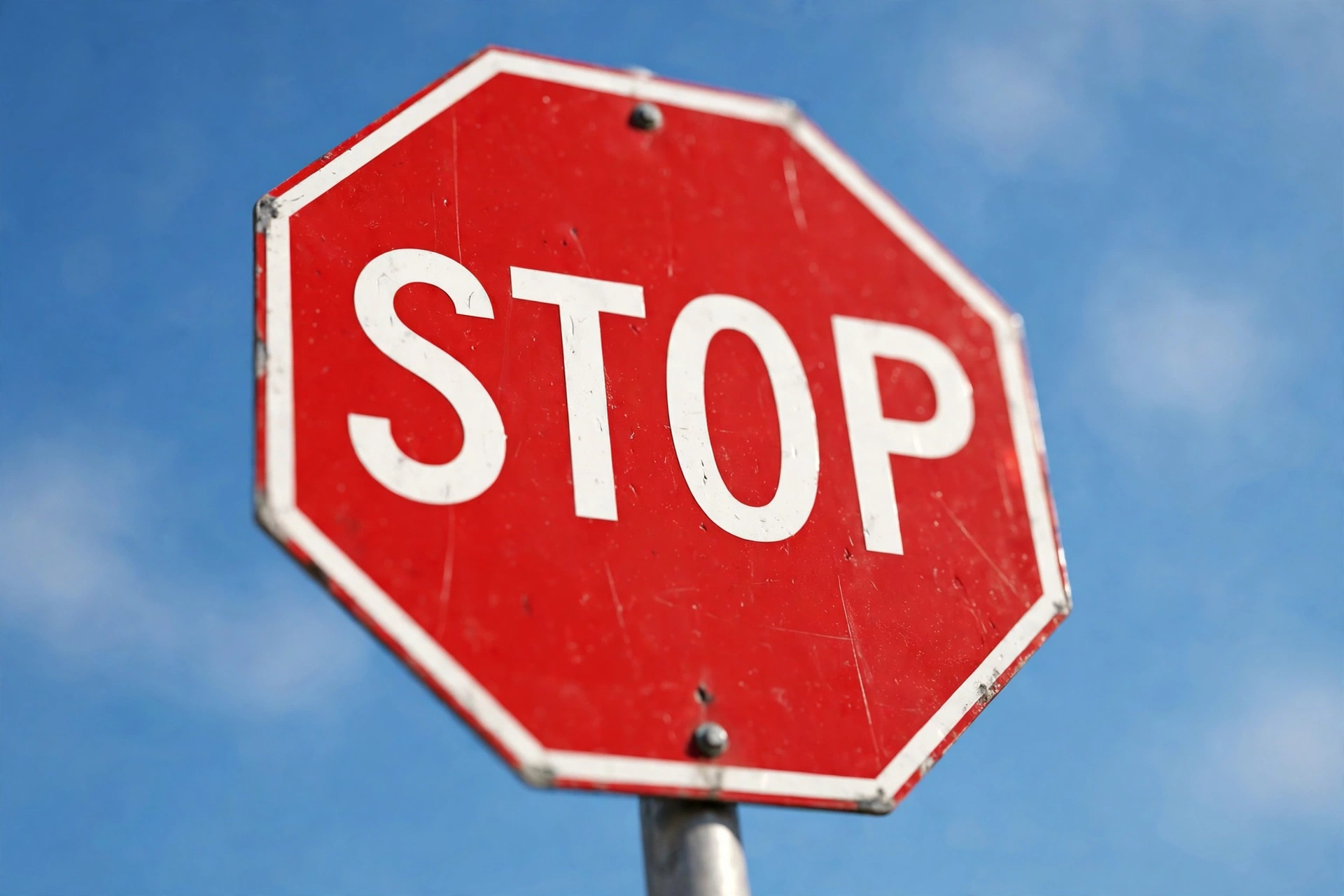
- Picture the stop sign. Red octagon. Four letters: S, I, G, N. The G is the quiet one.
Why this matters more than a spelling quiz
Here’s where it gets serious: a typo in an email is a moment’s embarrassment. A typo on a sign is large, public, expensive to fix, and visible to every customer who walks past. Signage is often a company’s first impression — a clean, accurate sign suggests care, and an error suggests the opposite, whether or not that’s fair.
Professionals in the sign industry consistently rank spelling mistakes among the most common and most expensive signage errors. And here’s the part that stings: the mistake usually isn’t caught at the keyboard. It’s caught at the installation — when the sign is already built, already paid for, and hanging where everyone can see it.
Which is exactly why the approval step exists. When we build a sign, the process runs: brief → free 3D mockup (targeted within two business days of a complete brief) → your review and sign-off → fabrication. That middle step — you looking at your actual sign, with your actual words on it, before anything gets cut — is where typos go to die. Nobody has ever paid to re-fabricate a sign because of a spelling error caught at the mockup stage.
So spell it S-I-G-N. Check it on the mockup. And if you want the deeper story of what signs are and how they work as a system, start with our guide to signage — see how we think about signage as a system — or browse common questions about ordering custom signs.
FAQs
Is the G in sign really silent?
Yes — in the base word, always. It only sounds in derived forms like signature and signal, where syllable structure exposes it.
What’s the difference between sign and sine?
They’re homophones: identical pronunciation, different spelling and meaning. Sign is the everyday word (message board, gesture, signature act); sine is the trigonometric function. Context decides.
Is it “signs” or “sign’s” for more than one sign?
Signs, no apostrophe. The apostrophe version is possessive (the sign’s brightness) or a contraction — never a plural.
How do you spell signage?
S-I-G-N-A-G-E. One G in the middle, pronounced SIGH-nij. It’s the collective noun for signs as a system.
Why does English keep silent letters at all?
Spelling preserves history. The G in sign records the Latin signum and the centuries when it was pronounced. English updates its sounds faster than its spelling — which is why the museum stays open.