
Drivers decide in seconds. If they can’t spot your business from the road, they keep going — and great service inside the building won’t change that. A well-planned pylon sign solves this by lifting your name above traffic, parked cars, and neighboring storefronts.
One thing to know upfront, stated plainly: UrbanSign Works does not fabricate pylon signs. Tall-pole structures need local engineering, local permits, and usually a crane on site — work that belongs with a full-service sign company near your location. This guide is an honest buyer’s orientation: what pylons are, what they cost in the open market, how permits really work, and how to choose the right builder. And if a pylon turns out to be more structure than you need, we’ll show you the lower-profile alternatives we do build.
Quick answer
A pylon sign is a tall, freestanding outdoor sign on one or more poles or a covered column, built to be read from a road at distance. Industry guides commonly quote a wide market range — roughly $8,000 to $200,000 or more depending on height, structure, lighting, and installation — but treat those as ballparks, not quotes; every pylon is an engineered structure priced to its site. Expect a sign permit plus a building permit, engineered foundation drawings, and zoning rules on height, size, and setback. Because UrbanSign Works doesn’t build pylons, choose a local full-service manufacturer that can engineer, permit, and install at your site — and compare their quote against lower-profile alternatives like a monument sign (fabrication from $2,900) when distance allows.
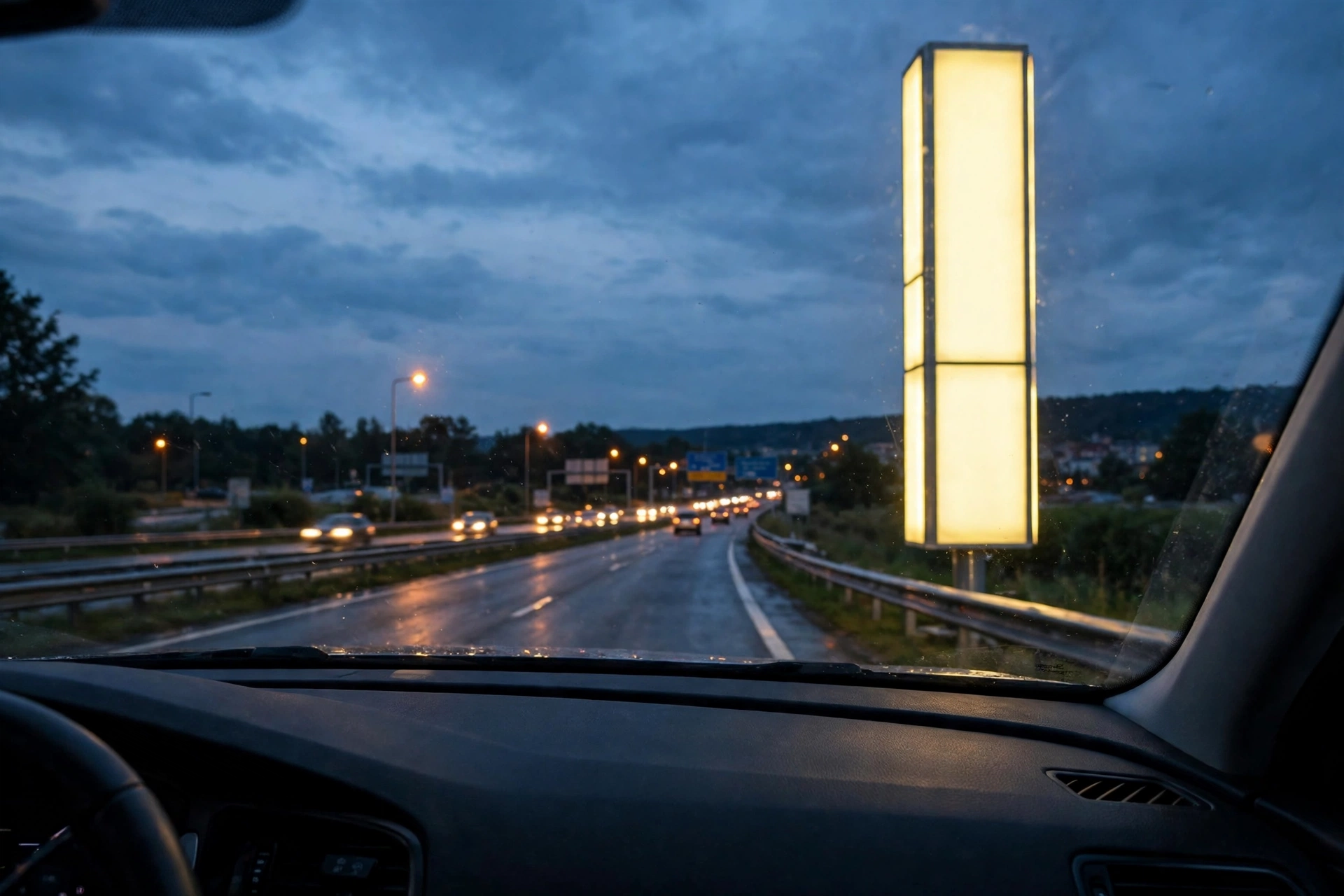
What is a pylon sign?
A pylon sign is a tall, freestanding outdoor sign mounted on one or more poles or a solid column, designed to display a business name or logo high above ground level so it can be read from a distance. It is not attached to your building — it stands on its own near a road, entrance, or parking lot, usually on a concrete footing engineered for local wind conditions.
Most pylons carry an aluminum cabinet with an acrylic or polycarbonate face, and many use LEDs for night visibility. You’ll hear the same structure called a freestanding sign, highway sign, or totem sign. The job is identical whatever the name: help drivers find your location early enough to slow down and turn in safely.
Pylon vs. pole vs. monument: don’t order the wrong structure
These terms get mixed up constantly, and the confusion leads buyers to quote the wrong structure:
| Pylon sign | Pole sign | Monument sign | |
|---|---|---|---|
| Height | Tall, far above eye level | Tall, on a narrow pole | Low, roughly 5–12 feet |
| Support | One or two poles, or covered column | Single pole | Solid base on the ground |
| Look | Larger cabinet, design flexibility | Simple, function-first | Architectural, upscale |
| Best for | Highways, busy roads, plazas | Fuel stops, quick roadside | Entrances, campuses, residential edges |
| Viewing range | Long distance | Long distance | Close range |
| Zoning approval | More scrutiny | More scrutiny | Usually easier |
In practice, many shops say “pole sign” for a simple single-pole design and “pylon” for a larger, more finished structure — often with a covered base or tenant panels. Because the terms overlap, describe your goal and site when requesting a quote instead of relying on the label.
The biggest practical difference from a monument sign is distance. A monument sign works on people already near your entrance; a pylon works on people still a block away. If your building is visible from the road and you mainly need an entrance statement, compare our monument signs — lower profile, usually easier to permit, and fabrication from $2,900.
Types of pylon signs
The right structure depends on cabinet size, wind exposure, and the image you want to project:
- Single-pole pylon — one central column, small ground footprint, clean modern profile. Suits standalone businesses with limited frontage. Because the entire load rides on one support, the pole and footing need careful wind engineering.
- Twin-pole and covered-pole — two columns for wider or heavier cabinets; covered-pole designs wrap the supports in brick, stone, or metal cladding so the structure reads as architecture. Hotels, medical offices, and corporate parks often choose this look.
- Multi-tenant pylon — stacked panels, one per business. Property owners like them because tenants share the cost and panels swap when leases change. Plan panel sizes early: top positions draw the most attention.
- Illuminated pylon — internally lit cabinets place LED modules inside so the face glows evenly; externally lit versions aim floodlights at the face. Digital message centers add changeable content for dealerships and fuel stations that update offers often.
What a pylon sign is made of
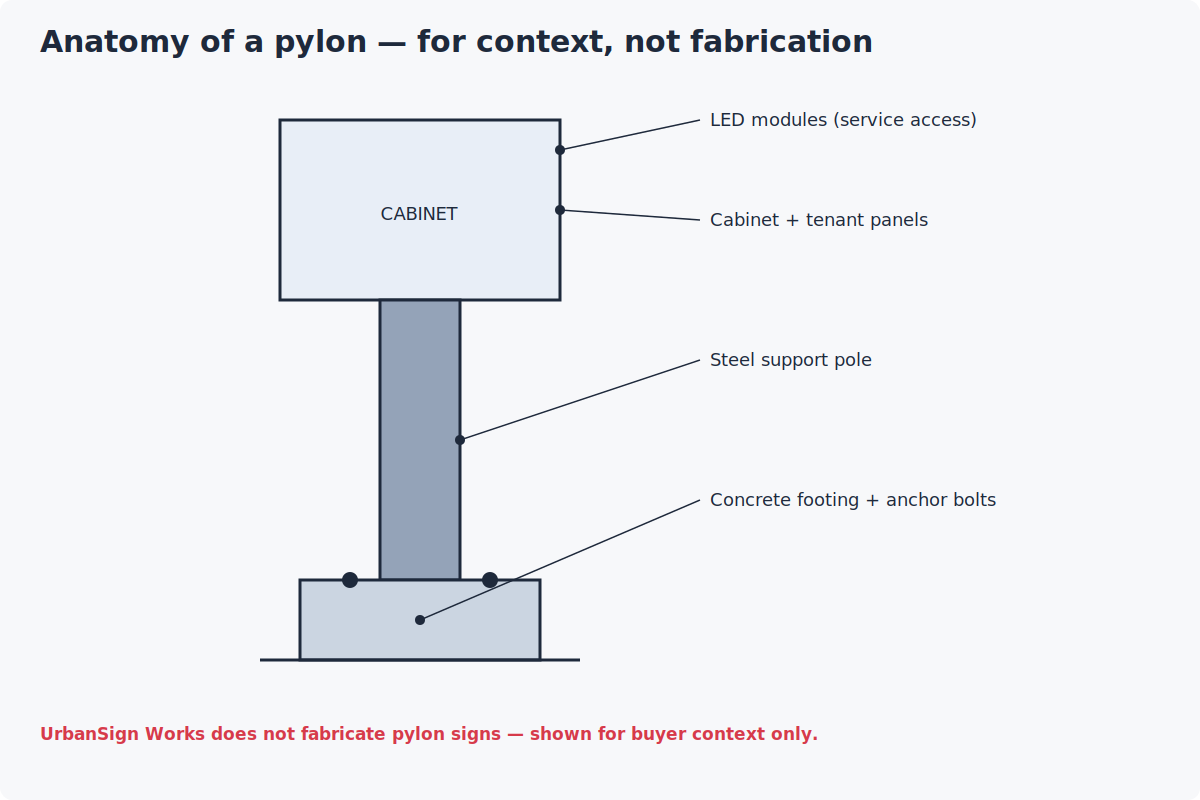
Every pylon shares the same core parts, and knowing them helps you read a quote with confidence:
- Sign cabinet — aluminum frame holding the face (acrylic, polycarbonate, or metal).
- Support poles — steel pipes or tubes, or a covered column, sized for height and wind load.
- Foundation — reinforced concrete footing with anchor bolts, designed for local soil.
- Lighting and electrical — LED modules, power supplies, wiring, weatherproof housings.
- Tenant panels or message center — swappable panels or a digital display when the message changes.
Aluminum resists corrosion and keeps weight down; steel brings strength where height demands it. Polycarbonate faces generally handle impact and UV better than basic acrylic — worth asking about if your site gets harsh sun.
How much does a pylon sign cost? (market context, not our pricing)
There is no single price for a pylon sign, because size, structure, and technology change the total. Industry guides commonly quote a wide range — roughly $8,000 to $200,000 or more — and you should treat these as market ballparks for orientation, not quotes. Compact single-tenant signs sit near the low end; large illuminated, multi-tenant, or digital structures climb quickly.
Illustrative example: the factors that move a pylon quote most are height and cabinet size; single vs. twin vs. covered-pole construction; lighting type (non-lit, LED, digital); number of tenant panels; foundation needs, soil conditions, and wind requirements; engineering and permits; and installation equipment such as cranes, plus shipping distance. A 20-foot single-pole cabinet and a 60-foot illuminated multi-tenant structure are different projects the way a shed and a house are different projects.
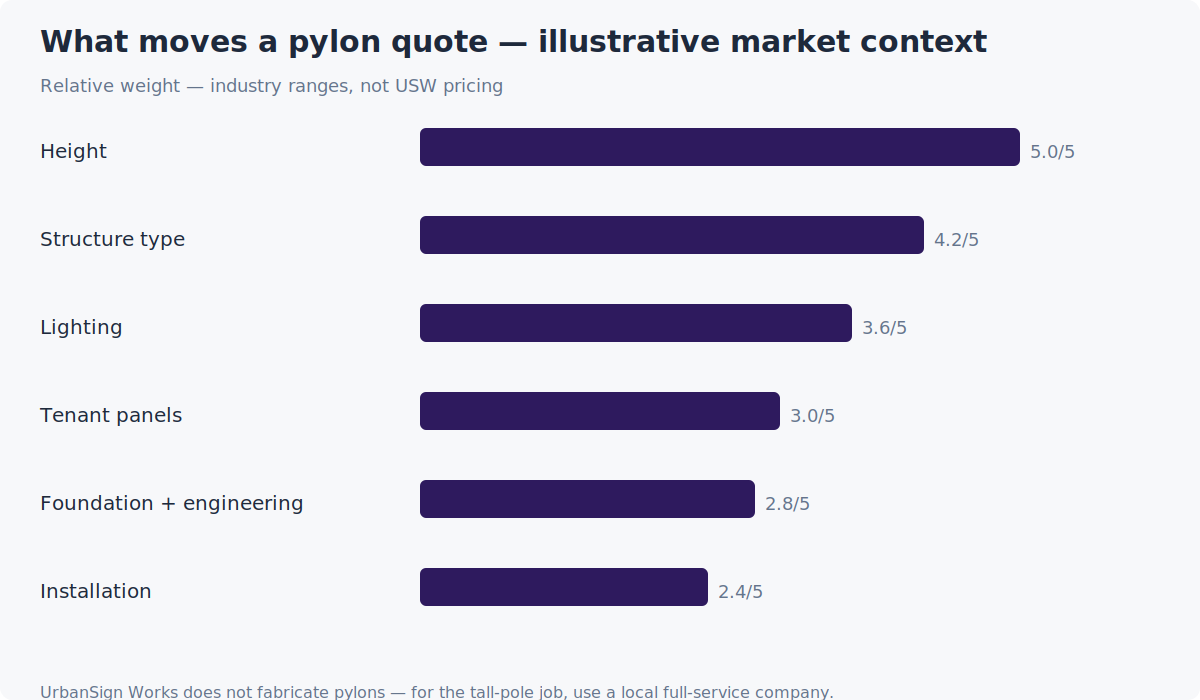
Budget separately for what first-time buyers forget: permits, foundations, engineering, and installation. A quote that covers only the cabinet is not a project price.
The comparison worth making: before committing to a pylon budget, price the lower-profile alternative. A monument sign with fabrication from $2,900 — plus channel letters on the building from $129/letter — often covers the same visibility job at a fraction of a pylon’s installed total, with easier permitting. Our business sign cost guide shows how pricing works across sign types.
Permits and local sign rules: the part that decides the project
Most cities treat a pylon as a regulated structure, not just a sign. Expect rules on maximum height, size, setback from the road, lighting brightness and hours (the Illuminating Engineering Society publishes the standards behind brightness limits), and structural safety. Requirements often include a sign permit and a building permit, and engineered drawings for the foundation and wind load — typically reviewed against the International Building Code as adopted locally. Highway-adjacent sites may need approval from a transportation authority. Historic districts and areas near homes are often stricter — and may steer you toward a monument sign instead.
Check the rules before you design. Redesigning after a rejection costs time and money, and height limits have killed more pylon projects than budgets have. This is also why pylons belong with a local builder: they know your city’s sign code, they have the engineer relationships, and they can stand in front of the planning board if needed. A factory hundreds of miles away can’t do that part — which is one reason we don’t take on pylon work.
Who actually needs a pylon sign?
A pylon makes the most sense when drivers need advance notice. Consider one if your building sits far back from the road or behind a large parking lot; trees, buildings, or vehicles block your storefront sign; you operate near a highway exit or on a fast-moving road; or neighboring businesses already have tall signs you must compete with. Gas stations, hotels, dealerships, and medical campuses are the classic cases.
But run the honest test first: can drivers see your building from the decision point — the spot where they must choose to turn in? If yes, a monument sign plus building-mounted channel letters or illuminated signs may do the job with less structure, less permitting, and a much smaller installed total. If no — if you’re invisible until the last hundred feet — that’s the pylon use case, and it’s worth paying for.
How to choose a pylon builder (since it won’t be us)
Searching “pylon sign makers near me” is a sensible start, because a local shop can visit your site. Compare these points before you commit:
- Who actually builds it? Some companies broker the work out. Ask where the sign is fabricated.
- Engineering support — can they supply stamped drawings your city will accept?
- Permit handling — will they run the permit process, or hand you drawings and wish you luck?
- Materials — aluminum or steel grades, face material, LED specifications, in writing.
- Installation — do they set the pole and wire it, or does that fall to you?
- Warranty — length, coverage, and who services it.
- Proof of work — a portfolio of finished freestanding structures, not just wall signs.
Get the quote itemized: cabinet, structure, foundation, engineering, permits, electrical, installation. A single lump sum hides the parts most likely to overrun.
Pylon maintenance and lifespan
A pylon is an outdoor structure — plan routine care. Clean the face with mild detergent and a soft cloth, check the lighting yearly, and inspect electrical components periodically. After storms or strong winds, look over the structure and foundation for cracks, yellowing, loose panels, and rust near the base. With quality materials and regular upkeep, many pylons serve 10 to 15 years, and LED modules typically outlast older fluorescent lamps. Fixing small faults early prevents larger repair bills.
FAQs
What is the difference between a pylon sign and a monument sign?
Height and viewing distance. A pylon is tall and built for drivers on the road; a monument sits low (usually under about 12 feet) and works at close range near an entrance. Monuments typically cost less and get approved more easily.
How tall can a pylon sign be?
Local zoning and engineering decide. Many commercial pylons stand roughly 20 to 30 feet; highway structures go much higher where the city allows. Check your local height limit before designing anything.
How much does a pylon sign cost?
Market guides quote roughly $8,000 to $200,000+, depending on height, structure, lighting, tenant panels, foundation, engineering, and installation. These are industry ballparks for orientation — get a written, itemized quote for your exact site.
Does UrbanSign Works make pylon signs?
No. We don’t fabricate pylon signs — tall-pole structures need local engineering, permitting, and installation that a factory can’t provide at distance. We build monument signs, channel letters, blade signs, dimensional letters, LED neon, and illuminated cabinets — the lower-profile family that covers most visibility jobs. Request a quote for those through our quote request, and we’ll tell you honestly if a pylon is what you actually need.
Can I put a pylon sign anywhere on my property?
No — setback, height, and size rules apply, and highway-adjacent sites may need transportation-authority approval. Your city’s sign code is the first document to read, before any design work.
The bottom line
A pylon sign is the right answer when drivers can’t see you until it’s too late to turn. It’s an engineered structure with engineered costs — budget the foundation, permits, and installation alongside the cabinet, and hire a local full-service builder who can engineer and permit at your site. And if the honest test says drivers can see your building from the decision point, skip the pole: a monument sign plus strong building signage does the job for less, with an easier permit path. Either way, the right structure starts with the viewing distance, not the catalog.
Next step: if a lower-profile solution fits your site, start with a free 3D mockup of a monument or channel-letter package — targeted within two business days of a complete brief. If you genuinely need a pylon, use the builder checklist above and get everything itemized in writing.