
Quick answer: Office lobby signs show your company name or logo on the reception wall or entrance area. The main options are acrylic panels, dimensional (3D) letters, metal letters, backlit or halo-lit signs, glass, wood, and vinyl graphics. Choose by wall type, lighting, viewing distance, budget, and building rules — then confirm mounting, lead time, and accessibility requirements with your supplier.
A lobby sign is often the first thing visitors read after they walk in. It tells them they are in the right place and quietly shapes how they see your business before anyone says a word. This guide explains the sign types, mounting methods, lighting options, cost drivers, and the checks many supplier pages skip.
What Are Office Lobby Signs?
Office lobby signs are branded signs placed in a building’s entrance, reception, or waiting area — usually on the wall behind the front desk. They include logo walls, reception signs, lobby plaques, and directory signs. They differ from room signs and wayfinding signs, which guide people through the building. Many offices use all three as one matching set.
If you are planning a full office signage package, it is worth reading about office signs generally — lobby walls, directories, and room identification usually work best when designed as one system with consistent materials and finishes.
Types of Office Lobby Signs Compared
Acrylic and dimensional letters suit most offices; metal, glass, and backlit signs suit premium or low-light lobbies. Details vary by supplier and finish.
| Type | Look | Best for | Check before ordering |
|---|---|---|---|
| Acrylic | Clean and modern; clear, frosted, painted, or printed | Most offices, detailed logos | Thickness, edge finish, mounting method |
| Dimensional (3D) letters | Raised letters that cast a shadow | Reception walls with bold logos | Letter thickness, wall type, install template |
| Metal (aluminum, steel, brass) | Solid, permanent, architectural | Law, finance, corporate brand standards | Finish, weight, fixing method |
| Backlit or halo-lit | Soft glow around or behind the logo | Dim lobbies, evening hours | Power access, approvals, LED warranty |
| Glass or etched-glass look | Polished and light | Partitions, conference areas | Weight and fragility; acrylic can mimic glass |
| Wood or mixed media | Warm and natural, often paired with metal | Creative or hospitality-style offices | Finish, humidity, bonding method |
| Vinyl wall graphics | Flat, bold, easy to change | Tight budgets, mission statements | Wall surface and removal later |
| Directory and wayfinding | Lists, arrows, and suite numbers | Multi-tenant or large offices | Changeable inserts for updates |
For bold raised lettering on reception walls, our dimensional signs cover the materials and fabrication options in detail. If you want your lobby logo to glow, illuminated signs for businesses explains backlit, halo-lit, and edge-lit approaches.
How to Choose the Right Lobby Sign
Start with the situation, not the style. These pairings are a practical starting point:
- Small office, simple logo — flat-cut acrylic or vinyl graphics keep cost and lead time manageable.
- Dark lobby or evening visitors — backlit or halo-lit signs, or a sign with spotlights, stay readable after hours.
- Law, finance, or corporate — metal or thick dimensional letters signal permanence and trust.
- Medical or dental — pair the logo wall with matching room, directional, and accessible signs so the whole office reads as one system.
- Multi-tenant building — directory signs with replaceable inserts avoid full replacement when tenants change.
- Likely rebrand soon — choose vinyl or panels that mount with simple fixings rather than permanent studs.
How Are Lobby Signs Mounted?
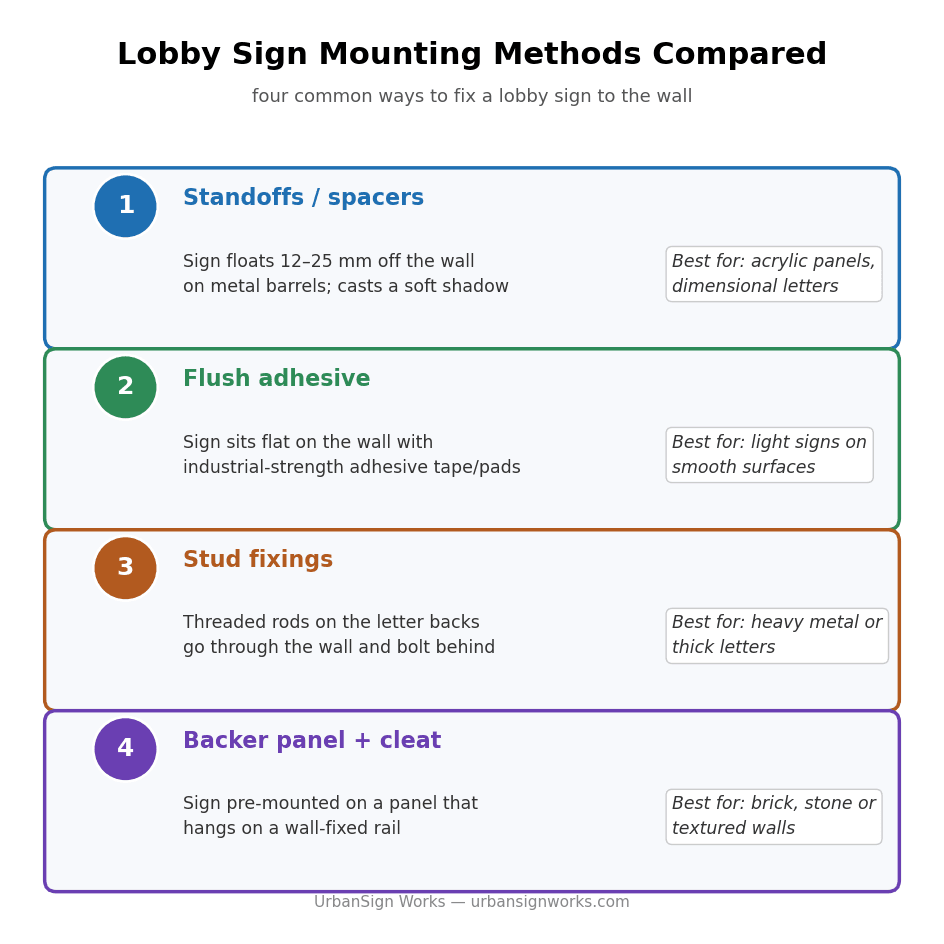
Most lobby signs use standoffs, flush adhesive mounting, or stud fixings, and the right choice depends on sign weight and wall surface. Confirm the method before ordering.
| Method | How it looks | Best for |
|---|---|---|
| Standoffs or spacers | Sign floats off the wall and casts a shadow | Acrylic panels and dimensional letters |
| Flush with adhesive | Sits flat on the wall | Light signs on smooth surfaces |
| Stud or threaded rod | Letters fixed through the wall surface | Heavier metal or thick letters |
| Wall clamps or drilled holes | Visible hardware, can be a feature | Plaques and panels |
| Backer panel or cleat | Sign is pre-mounted and hangs on a rail | Brick, stone, or textured walls |
Humidity and strong air conditioning can weaken some adhesives, so ask your supplier to recommend a method for your climate and wall material. A good supplier will also provide an installation template for 3D letters — worth asking about, since it makes alignment far easier.
Which Lighting Works for a Lobby Sign?
- Backlit or halo-lit: LEDs behind the letters create a glow on the wall. Check power access and the LED warranty. Halo-lit lobby signs are a popular premium look — our overview of illuminated signs shows how the effect works.
- Internally lit: The face itself glows. It reads clearly in low light and works well for logos on dark feature walls.
- Externally lit: Ceiling spotlights or gooseneck lamps highlight unlit letters and create a floating effect. Often the most cost-effective way to add drama to a metal or dimensional sign.
- Unlit: Works well in bright lobbies and keeps cost down. A surprising number of premium lobby signs are unlit — the material does the talking.
Where Should You Place a Lobby Sign, and How Big Should It Be?
Place the main sign on the wall visitors see as they enter, or behind the reception desk, and size it for the farthest viewing point.
- Wall proportion: About one third to one half of the wall width usually looks balanced. This is a design guideline, not a standard.
- Letter height: A common signage rule of thumb is about 2.5 cm of letter height per 3 m of viewing distance. Some retailers publish more generous ratios, so use the cautious figure as a minimum.
- Avoid: Doors, plants, glare, and the desk blocking the view.
| Viewing distance | Minimum letter height |
|---|---|
| 3 m | 2.5 cm |
| 6 m | 5 cm |
| 9 m | 7.5 cm |
| 12 m | 10 cm |
Increase letter height for thin, script, or low-contrast designs.
Worked Example
Reception wall: 3.6 m wide. Visitors first see it from the door, about 8 m away.
- Width: one third to one half of 3.6 m gives about 1.2 m to 1.8 m.
- Letter height: 8 m ÷ 3 m × 2.5 cm is about 6.7 cm minimum. With a thin font, choose 9 to 10 cm.
A 1.5 m wide sign with 10 cm letters fits both checks. When you are ready to turn measurements into a real design, get a free 3D mockup to check size and proportions on a photo of your actual wall before fabrication begins.
How Much Do Office Lobby Signs Cost, and How Long Do They Take?
Cost depends on size, material, lighting, logo detail, and installation — and published prices vary widely by supplier and region. Use the ranges below only to understand the spread, then request current itemized quotes.
| Example from US supplier pages | What it tells you |
|---|---|
| Acrylic logo signs listed from about US$300 | Simple flat or cut acrylic sits at the lower end |
| Lobby signs from about US$700; backlit from about US$1,200 | Lighting and fabrication push the starting price up |
| Custom 3D lobby signs quoted at roughly US$300–US$1,200+ | Size, material, and finish drive the range |
| Dimensional letter installation reported at roughly US$200–US$800 | Installation can be a separate line item |
| Dimensional acrylic or metal in about 7–10 business days, or 3–4 weeks from artwork approval | Lead times differ between suppliers |
These figures are examples, not quotes. Ask each supplier what the price includes: design, mockup, shipping, installation, wall preparation, and warranty. For more on what drives custom sign pricing generally, see our FAQ.
How to Order a Lobby Sign: Step by Step
- Get approval. In a multi-tenant building, ask the landlord or property manager what is allowed — size, materials, and fixings may all be restricted.
- Measure and photograph. Note wall size and material, power points, and viewing distance from the entrance.
- Prepare your logo. Send a vector file (AI, EPS, or SVG) and brand colors if you have them.
- Request a mockup. Check size and proportions on a photo of your wall before anything is cut.
- Confirm specifications. Material, thickness, finish, lighting, mounting, warranty, and lead time — in writing.
- Install and test. Use a template for 3D letters, and a qualified electrician for hardwired lighting.
Opening before the sign is ready? Fabrication can take days to weeks. Ask about a temporary printed sign or vinyl graphic so the lobby is not blank on day one.
Accessibility and Building Rules to Check
Rules depend on your country, building, and sign type, so check them before you order. In the United States, the 2010 ADA Standards (section 216.2) require signs that identify permanent rooms and spaces — such as restrooms and room numbers — to have raised characters with Braille. A decorative logo wall is usually exempt, but it is sensible to price matching accessible signs at the same time so the whole office feels consistent.
Lit signs may need electrical approval, and a property manager may set limits on size, position, or fixings. Confirm all three before production starts.
How to Care for a Lobby Sign
Dust regularly, clean with a soft cloth and a product the maker approves, and switch off lit signs before cleaning. Check fixings and cables occasionally. Harsh chemicals can mark acrylic and specialty finishes — when in doubt, ask the manufacturer what to use.
Frequently Asked Questions
What is the purpose of an office lobby sign?
It identifies your business, supports your brand, and helps visitors confirm they are in the right place. Matching directional signs help them find their way from there.
What material is best for an office lobby sign?
No single material wins. Acrylic suits modern, detailed logos; metal suits permanence and corporate gravitas; glass suits partitions; vinyl suits tight budgets. Choose by wall type, budget, and brand.
How are lobby signs attached to the wall?
Common methods are standoffs, flush adhesive, stud fixings, clamps, and backer panels. The best choice depends on sign weight and wall surface — always confirm the method with your supplier before ordering.
How long does a custom lobby sign take?
It varies by supplier, material, and design. Published times range from about a week or two to several weeks, so ask for production and installation time separately.
Can I update a lobby sign after a rebrand?
Vinyl, panels, and changeable inserts are easy to update. Fixed dimensional or metal letters usually need replacing, so plan for change if you expect a rebrand in the next few years.
Do lobby signs need to meet ADA rules?
In the US, permanent room identification signs usually do (raised characters plus Braille under the 2010 ADA Standards), while a decorative logo wall usually does not. Check your local rules and ask your supplier.
How much do office lobby signs cost?
Prices vary by size, material, lighting, and installation — roughly from a few hundred dollars for simple acrylic or vinyl up to several thousand for backlit metal or large dimensional installations. Always ask for an itemized quote to compare options fairly.
Should a lobby sign match my other office signs?
Yes. When lobby walls, directories, and room signs share materials and finishes, the whole office reads as one brand. Planning them together is usually cheaper than matching a new sign to an existing one later.
Conclusion
A good lobby sign is readable from the entrance, suited to the wall, and consistent with your brand. Choose the type for your situation, confirm mounting and lighting, size it for the farthest viewer, and check building and accessibility rules before production. Next step: photograph your lobby wall, measure it, and ask a sign maker for a mockup with an itemized quote.
Guidance is general — specifications, prices, and rules vary by supplier and region.
Start With a Mockup, Not a Guess
Send us a photo of your lobby wall and your logo. We will recommend materials and mounting for your wall type, build you a free 3D mockup showing the finished sign at real scale, and quote it factory-direct with an itemized breakdown.